We have one planet; we all share it; global warming is a global problem. To make the shift to renewable energy, hard choices must be made and political will is required in every city, county, state, country... If we don't make the hard choices now, Mother Nature will make them for us, without compassion, whether we're ready for them or not.
Thursday, September 1, 2022
Sunday, August 21, 2022
Batteries Make Everything Great About Solar Even Better
Solar is great. Solar plus batteries is even better.
When you generate your own electricity with solar, you have a level of energy independence. You have some insulation from electricity price fluctuations from your utility. When you add batteries to the mix, things get even better.
Batteries allow you to time-shift your solar use and they allow your solar system to continue to operate when the grid is out. That's right, most solar PV systems shut down when the grid is down. But if you have batteries, you can continue to produce your own power and keep the lights on.
In addition to these benefits. Batteries buffer grid demand and fill in the solar production gaps that passing clouds can cause... To illustrate this, I'll show you the energy use of our home on a hot August day. You can see the energy perspective from our home and how solar plus batteries radically changes how this appears to the grid.
The above image shows our home electricity use. You can see that our electric cars start charging at midnight and both were fully charged by 3AM. The spikes that happen throughout the day are for the air conditioner. As you can see, as the AC cycles on and off, our electricity demand cycles up and down accordingly.
Now let's look at the solar production for this day.
![]() |
| Solar production on a hot, cloudy summer day |
This particular day was bright and cloudy. The passing clouds caused spikes and dips in solar production.
Looking at the two images above, you can see that we have spikey production caused by clouds and spikey demand caused by an AC unit turning off and on. How did these two interact and what was the resulting grid demand? See below:
![]() |
| Day's Grid Usage |
You can see that at 6AM we stopped using the grid. In the afternoon, we exported some solar production. We didn't start using the grid again until late in the evening at 10PM. This is a big deal. During the day, electricity prices are at their highest and we aren't using the grid at all during this time.
How can the grid use be negative during the day? How were all of these spikes in both production and supply resolved? Batteries.
![]() |
| Battery Usage (~charging AM, discharging PM) |
Batteries supplied energy before the sun came up; they were the buffer that supplied energy when the clouds passed. Batteries filled in the gaps when the AC kicked on and we needed more than the solar was currently providing. After the sun went down at 8PM, batteries exclusively powered our home until 10PM.
Looking at the image above, you can see at 6AM the batteries started discharging (above the line). By 7:30AM the sun was producing more than our home needed and the batteries started charging (below the line). By 1PM the batteries were full. From here the batteries alternated between charging and discharging always making sure that the grid didn't need to be touched with anything other than surplus solar production.
By 5PM the solar production was not enough to power our home. The batteries started discharging, working cooperatively with solar, and taking on more and more of the home load as the sun was setting and solar production was fading for the day.
At 10PM the price to use the grid is back to its cheapest rate, so the battery shuts off and our home went back on the grid.
For us, our 12 kW solar array is not enough for us to be 100% self-powered, but (with batteries) it is enough to ensure that we're off-grid when electricity prices are the highest. We're on a time-of-use fee schedule. From 10PM till 6AM is off-peak time. This is when rates are the cheapest. This is when the grid has surplus capacity. This is when wind energy production is generally at its highest. This is when the dams have to keep some minimal amount of water flowing downstream for water quality, even if the power is not needed.
Shifting our grid demand to 100% off-peak means that the existing infrastructure is better utilized. And it means that we don't have to pay the higher prices for electricity at mid-peak or peak times.
So if you have solar or you are considering solar, I suggest adding batteries to the plan.
Sunday, August 7, 2022
Tesla's Biggest Advantage
In many ways, Tesla is unlike other car companies. It's not just that they aren't saddled with a legacy combustion business; there are EV start-ups like Lucid and Rivian that are similar in this respect. So what is it that makes Tesla different?
We've previously written about some of these differences here (Tesla's moats) and here (Tesla is far more than a car company.) These moats certainly are important; however, this entry is not going to repeat those. Rather, this entry is about an additional advantage, one that isn't structural, and perhaps it's their biggest advantage.
![]() |
| A Matryoshka of Tesla Superchargers |
Tesla was founded in 2003 (almost 20 years ago). Prototypes of their first car (Tesla Roadster) were officially revealed on July 19, 2006, during an invitation-only event at the Santa Monica Airport.
Unknown Unknows
While creating Roadster, they ran into problems. Problems that they didn't even know existed until they tried to make something. The battery pack didn't fit into the existing Elise design. The motors controllers from ACP were hand-tuned analog devices; fine for a prototype, but not consistent nor scalable. Another unforeseen problem, there were no existing transmissions that could handle the torque that these powerful motors delivered.Tip of the Spear :: The Earliest Early Adopters
The Benefit of Time and Iteration
When you are trying to solve a big problem (such as how to make a fast, affordable, long-range EV) you run into a lot of smaller problems along the way. The problems often have layers and you must keep "peeling the onion" to solve them. It's a recursive nest of problems until you finally solve a fundamental issue, solving this allows you to pop-the-stack; reversing back up the layers, unwinding the problems of each layer with solutions from the layer below.
![]() |
| Innovation Flywheel |
The faster that you can move around this loop, the faster your products improve. Tesla does not restrain themselves to 'model years' because this slows down their innovation time. Instead, the vehicles have detailed computer models that let employees test things out in virtual space first. If the computer models show that this would be a better product (better range, performance, cost, build time...) then it is prototyped and tested. A small change could go from idea to rolling out the door in new cars later the same day.
As changes are made, the software in the car is updated to recognize this change and self-test this new functionality as each car rolls off the line. Each car is its own unit test system. This helps ensure quality and it allows the cars to self-diagnose issues when service is scheduled. This built-in self-test provides a safety net for innovation. If a change introduces an unexpected second-order effect, one of the thousands of self-tests can catch it before the vehicle goes out the door.
Now Versus Then
Tesla has had the advantage of time. They've had more than a decade of runaway to make mistakes. The 2012 Model S won Car of the Year when it came out. If a startup were to release a car like that today, it would be panned as slow, short-ranged, inadequately thermally managed..., compared to the Model S of today.
Tesla's biggest advantage is that they didn't have to compete with anyone else that was a pure-play EV manufacturer for the first decade and a half of their existence. Or said another way: Tesla's biggest advantage is that during their stumbling, skinned knees, learning, ramp-up mode, they didn't have to compete with, well, Tesla.
Tesla's biggest advantage is that they didn't have to compete with Tesla.New Start-Ups Have A Bigger Challenge
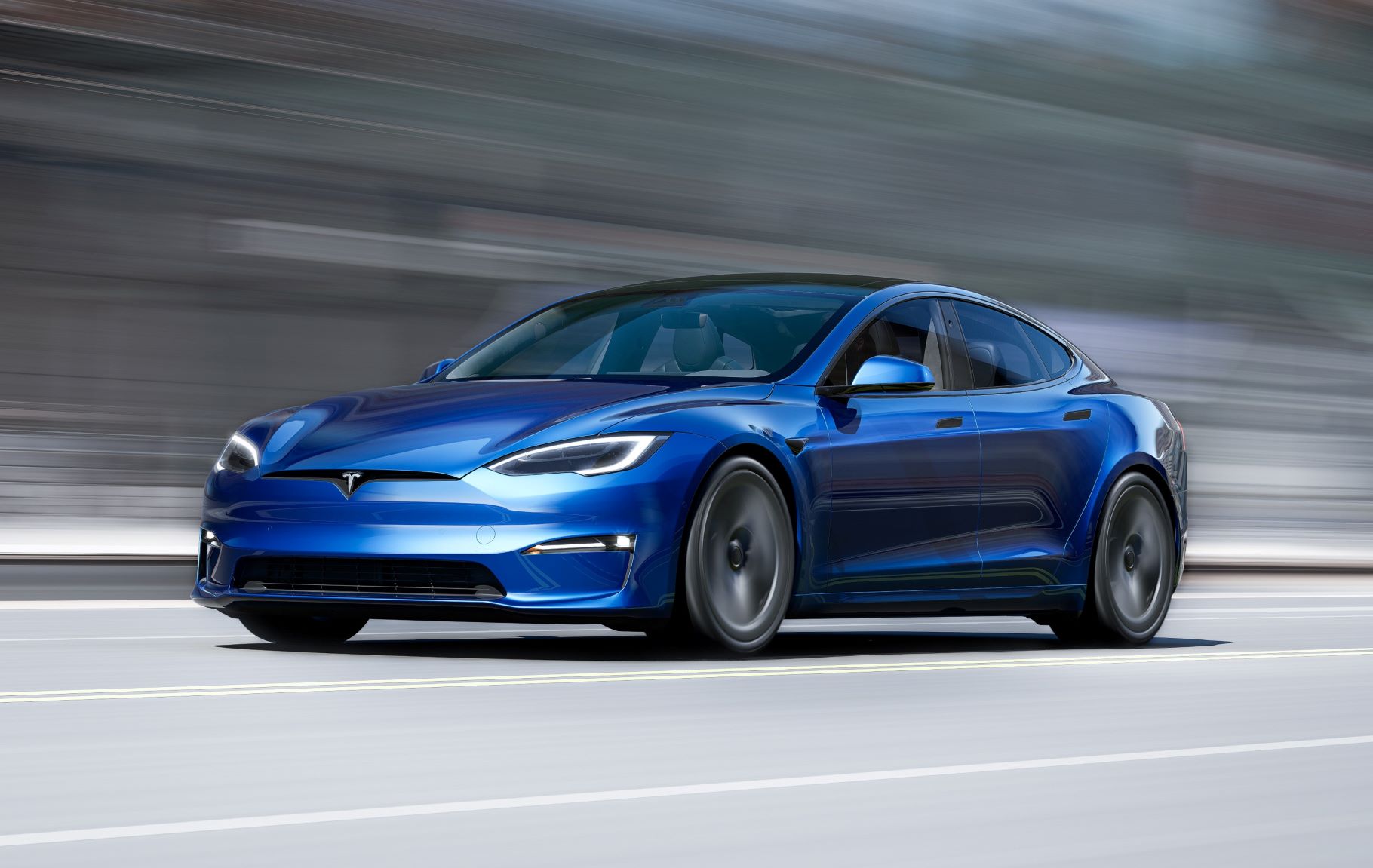
2012 Model S compared to 2022 Model S
![]() |
| 2012 Tesla Model S |
![]() |
| 2022 Tesla Model S |
| Model S | 2012 85 RWD |
2022 Long Range Dual Motor |
|---|---|---|
| Price (Long Range) | $115,050 | $99,990* |
| Price (inflation adj.) | $144,069 | $99,990 |
| Range (miles) | 265 | 375 |
| 0-60 | 4.3 sec | 3.1 sec |
| Autopilot/FSD | None - no cameras (AP was intro-ed in 2014) |
AP standard, FSD Upgrade $12,000 |
| Supercharging Rate (kW) |
90 (5 miles/minute max) |
250 (11 miles/minute max) |
| Gaming | Chess, Backgammon, a few 80s arcade games |
Equivalent to modern game console, Steam client support planned |
Sunday, July 17, 2022
Air Quality
|
|
| Air Filter |
This unit has an ionizer, but we are leaving that feature turned off since ionizers can cause throat irritation and other problems, especially when used in enclosed spaces.
Saturday, July 2, 2022
Ski Trip in Tesla Model X Gone Wrong!
In February of 2022, we drove our 2016 Tesla Model X on a little ski trip and things didn't go as planned. I've waited awhile to tell this story. I wanted to have some perspective and not just gripe about the things that went wrong.
We've taken the Model X on many ski trips. Our vehicle has the cold weather package and pre-heating allows you to stay comfortable even after the vehicle sits in a cold parking lot all day. The winter tires were on; we were packed and ready for snow.
We'd rented a condo with friends for a few days at Collins Lake Resort in the little town of Government Camp, Oregon on Mt. Hood.
One Cold Night
On the way there we charged up in Sandy, Oregon and arrived with no problems. We unloaded, schlepped into our temporary abode, and looked forward to hitting the slopes the next morning. That night, an Arctic blast made its way into the Willamette Valley setting record low temps in the region.
It's ironic to be discussing the coldest night of the year while most of North America is currently in the middle of a heatwave (I'm writing this in July). I guess we all need to get used to more weather extremes.
As you can see in the image above, it got down to 2F (-17C) where we were staying. Unfortunately, the condo we'd rented didn't have a garage, so our car was out in the cold (not plugged in) getting covered with snow.
No problem. The battery was ~70% full and the car knows to keep its battery comfortable. The next morning, I opened the app, noting that we had not lost much range overnight. I turned on the car's pre-heat function, grabbed the ice scraper, and headed out to the car.
While pre-heating, I brushed the snow off and scraped the windows, then we loaded up the car with gear and passengers, and hit the road. From the pre-heating, the seat was nice and warm as we headed to the ski area.
Things Go Bad
After about 20 minutes on the road, the front window started to fog. In response, as I've done hundreds of times before, I double-tapped the front defrost button. Why double-tap? The first tap turns on AC to defrost mode, whereas the second tap uses the heater to defrost. Since it was cold out, I wanted to use the heated defrost mode.
The defroster set the heat to "HI" and that's when things went awry. Error tones and a string of alert messages popped up.
| Tesla Error Code BMS_w035 |
Most disturbing among these was a message that read the "vehicle may not restart." At this point in the drive, we were nearly at the ski area. What am I supposed to do? Do I ignore it and hope for the best, perhaps stranding my family and myself on the mountain if it won't restart? Do I immediately turn around and head to the Tesla service station (~65 miles away) even though we've paid for 2 days of lift tickets and 2 more nights in the condo? Do I call roadside service or a tow truck? This and more runs through my head as I drive on a snow covered road with a foggy window. I wipe the window and decided to keep going.
We made it to the ski area and parked. I pulled out the app and made a service appointment. The app made it easy since one of the reason-for-service options was "recent alerts." I selected this option, selected the alert, and then was given several dates to pick from. The earliest was March 18th. That was 23 days later.
Rather than call a tow truck, I decided to take my chances. Maybe the 12V was cold and the alerts would clear up. The alert text said, "Vehicle may not restart." Which means there's also a chance that the vehicle may restart. I was putting my hopes on that word may falling in my favor. So we hit the slopes and hoped for the best. It was a great day for skiing with light snow falling most of the day. However, for me, too much of my mental energy was worried about the car to actually enjoy the moment.
Luckily for us, when we got back to the car, it started. The error codes persisted, but we were not stranded. As we made our way back to the condo, the heat was not working and there was ice on the windshield wipers which made it difficult to see. I had pre-heated the car, but apparently whatever had gone wrong had taken the heating system down too. I pulled over and scraped the ice off the wipers and the windows so I could safely make the return trip.
For day 2 on the slopes, we left the Tesla at the condo. We were on this trip with friends and we were able to all squeeze into their car for the short trip to the ski area. Day 2 on the slopes was excellent. It was a bluebird ski day. There was fresh powder from the night before and the skies were clear and sunny.
| Our bluebird day on Mt Hood |
We had an excellent day on the mountain and I didn't have to worry about a ride back. After day 2 of our ski fun was done, we had another night at the condo, and then it was time to head back to the real world. Leaving the condo, we packed up the Tesla Model X, all the while I was wondering if it would get us home. I performed a "two-button reboot" to see if the errors would clear up. They persisted, but (just as it had in the parking lot) it started up.
Leaving The Mountain, Heading Home
Heading down the mountain, there was no regenerative braking. This significantly changed the feeling of driving. I'm not used to using the physical brakes for minor slow-down moments; single-pedal driving is one of the nice things about EVs and I had lost this feature. With regen disabled, it just felt weird -- it didn't feel like my car. And this was while going down a mountain, the perfect scenario for regen.
We made it to the Supercharger in Sandy, Oregon and plugged in. The supercharging session started out fine and then stopped with yet another error message. The battery was far from full. The in-car nav said we had just enough to make it home but I had to wonder if it was including the fact that regen was disabled in this calculation? To be safe, I assumed this edge case was not covered in the nav's range calculation and I didn't want to end up stranded just a few miles from home. So, I unplugged from the Supercharger, rebooted the car, and tried Supercharging again. Again it started charging. We finally had enough to safely make it home with a margin of safety. Just as I was getting out to unplug, we had another round of alerts.
Here are the error messages we received this time:
| Tesla Error Codes: BMS_u008, BMS_w172 |
Service
We made it home. Despite the "reduced acceleration and top speed," we had no problems driving at freeway speeds or taking hills. A nerfed Tesla is still more than enough performance for typical driving. After pulling into the garage, I shifted into Park and I had no intention of driving it anywhere (other than to the service center). So our X sat in the garage with the snow and ice melting off the wheel wells and undercarriage, leaving clumps of the red lava rock (used to 'sand' the snowy roads here) on my garage floor.
Twenty days later it was our turn at the service department. Even though we had to wait, the nice thing was that service was able to pull the logs remotely and, based on the specific error codes, order the parts needed for the repair (+1 for connected cars/computer-on-wheels). About a week before my appointment, Tesla service contacted me and told me the parts had arrived and if any spots opened before my scheduled appointment, they'd try to get me in early.
Since the car was going in for service, I decided to have a few other little things taken care of while it was there. It was the end of ski season and I was certainly not taking the X back up to the mountain this season, so it was the time to swap back to all-season tires; the wiper blades were worn; and my 12V battery was still the (now well-aged) 2016 factory installed battery. The 12V battery had nothing to do with these errors (according to the service center), but I had just been reading accounts of similar age 12V batteries giving up the ghost, so I wanted to replace mine before it started causing problems.
Sadly, no early slots opened, but our turn finally arrived. I dropped off the car and Uber-ed home on the Tesla provided credits.
A couple days later, service contacted me. While doing the repair, they determined that the traction battery contactors had to be replaced. This portion of the repair was covered under the HV battery warranty (so no additional cost), but it meant that additional parts had to be ordered. They offered me a loaner, so I went in and picked up a white 2017 Model S.
Seventeen days later the additional parts arrived. I breathed a sigh of relief. Given the supply-chain troubles that are currently plaguing nearly every industry, this could have been a much longer wait time.
Just 3 days after this, I was informed that my repairs were done and I went in and picked up my car. The vehicle was still dirty with mountain road grime (I miss the days when service washed your car), but I was happy to have my ride back.
How Much Did It Cost?
Here's the snippet of the receipt:
![]() |
High Voltage Battery Coolant Heater Repair Bill |
June Update
Just when I thought it was all over. Months later, a new error message popped up.
![]() |
| Tesla Alert THC_w0105 (yes, I need to clean that screen) |
Wrapping Up
In total, from the day of the failure to fully repaired (pre-leak), it was 44 days and we paid about $1100. Adding the costs in June and the total is over $1600. This is part of the 'pain' of owning a vehicle that's no longer under warranty. I've owned this vehicle for five and a half years, prior to this failure, it has performed excellently. I hesitate to call this a "major failure" since I was able to drive home (and even Supercharge). All machines break down at some point. I'm just glad that we were not stranded when this failure occurred. Time to start saving for my 2025 Model X upgrade.
Thursday, June 23, 2022
Welcome to Summer
Summer 2022 has officially arrived in the northern hemisphere! The June solstice was the kick-off and, since that's the longest day of the year, I like to mark the occasion by sharing our solar production.
![]() |
| Solar Generation On June 21st, 2022 |
Here in the NW corner of Oregon, the sun rose at 5:23 AM and didn't set until 9:04 PM. That's 15 hours and 41 minutes of daylight. As the graph above shows, our PV system was cranking out power from 6 AM until 8 PM. We generated a total of 76.5 kWh of energy.
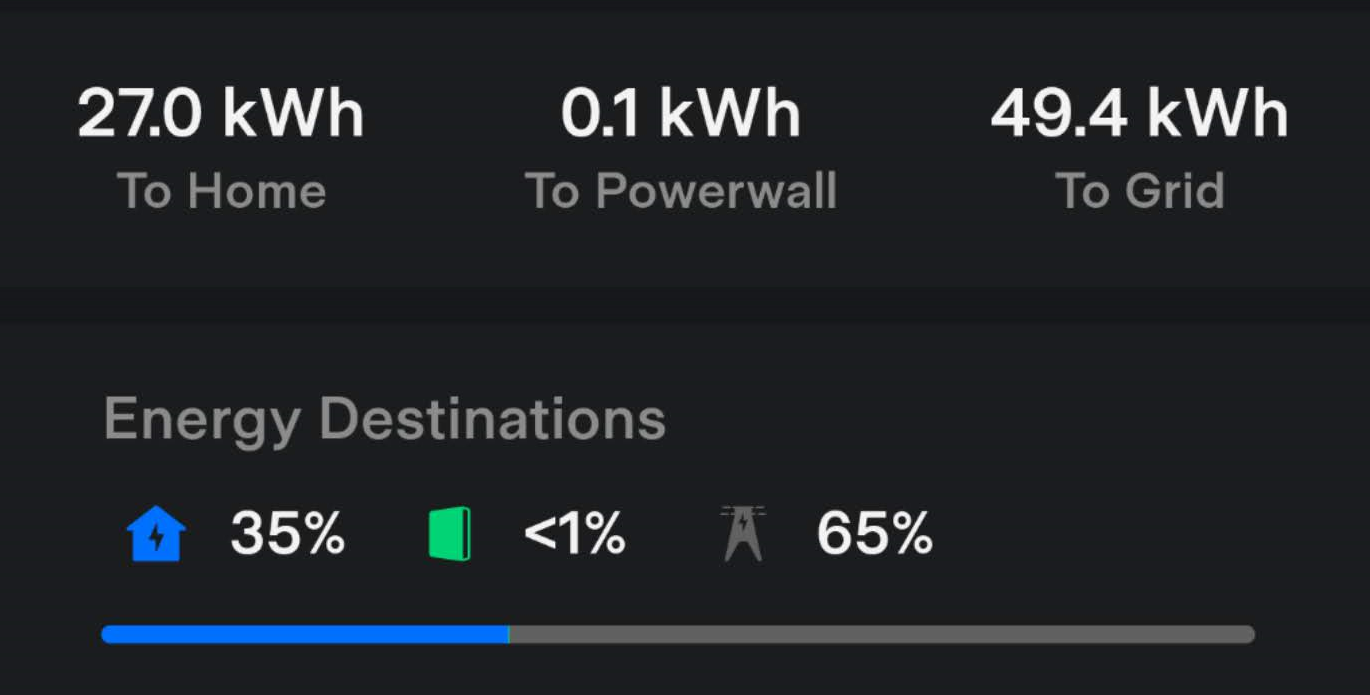
![]() |
| Destinations of our Solar Production |
As you can see, about one-third of the energy was used to run our home. The bulk of the remaining two-thirds was sent to the grid, running our meter backwards for most of the day.
How Much?
On this one day, we generated 76.5 kWh of energy; just for fun, let's look at this amount of energy in several ways.
76.5 kWh of energy is equivalent to:
- 2.5 days of use in a typical US household
- 203 Million foot-pounds
- 261 BTUs
- 65822 food calories (about 132 meals)
- 306 miles in a 2022 Tesla Model 3 standard range
Obviously, this energy cannot be converted directly into food calories or meals. I'm just trying to put some perspective on the number.
The 306 miles in a Tesla is interesting and the energy can be directly used in an EV. Looking at fuel averages, a 306-mile trip would typically use about 15.3 gallons of gasoline. At current gas prices, that's about $76 dollars. Not a bad day's work. :)
Sunday, June 5, 2022
Tesla's Eye In the Sky
Tesla's vehicles are flush with sensors. They have 360-degree cameras, sonar, temperate sensors, GPS, accelerometers... These are intended primarily for Tesla's Full Self-Driving, but what other purposes could they serve?
What data could these computers on wheels gather? Here are a couple of ideas:
Collecting and reporting traffic is an obvious example. There are many smartphone apps that already have similar functionality. This would certainly help for route planning to avoid traffic (assuming you can't take a tunnel).
Another suggestion that was posted on Twitter was for Tesla vehicles to collectively look for license plates associated with Amber Alerts and, if spotted, report the location to the appropriate authorities. This could save children, but it is also a little creepy to know that Tesla cars could be reading all the license plates around them.
What other ideas do you have for a massive fleet of internet-connected robots?
Friday, May 20, 2022
Saving Money with Solar
A friend said he was considering solar and batteries for his home, but the economics just didn't pencil out. The payback time would be more than a decade and that didn't seem worth it. He is looking at getting a 14 kW system. He then asked how much we saved with our 12 kW system (with 40kWh of batteries).
As you can see in the chart above, we generated $2193 worth of electricity in 2021.
The dollar amount is important, but it is far from the complete story. Before I jump into the complexity, here are some more easily digestible graphs from our solar app:
And finally off-peak. This is generally overnight, so we are not going to have any solar during these hours. The exception to this is Sunday (and some holidays). The Tesla solar app currently does not handle this very well. They only have a "weekend rate" and it does not allow Saturday and Sunday to be on different billing schedules. So this is not accurate since there should be 52 Sundays and 6 holidays worth of off-peak solar generation. They have made several TOU improvements in the solar portion of the Tesla recently; I hope this is improved soon too.
Electricity Bills
Let's make this bill understandable. First, we'll split things into fixed charges (items that will be there every month regardless of our use) and variable charges (items that change with use). And, just because nothing can ever be simple, a couple of the fees are a percentage, so they are variable, but not per kWh, applying to both fixed and variable fees.
| Charge | Amount |
|---|---|
| Basic Charge | $11.00 |
| First Block Adjustment | -$7.22 |
| Smart Battery Reward | -$20.00 |
| Low-Income Assistance | $1.04 |
| Oregon Commercial Activities Tax Recovery (portion applied to fixed charges) |
$0.015 |
| Public Purpose Charge (portion applied to fixed charges) |
$0.055 |
| Fixed Cost Subtotal | -$15.11 (credit) |
| Off-peak | Partial-peak | Peak | |
|---|---|---|---|
| Basic Rate | 4.128¢ | 7.051¢ | 12.38¢ |
| Fully Adjusted Rate | 5.336¢ | 16.536¢ | 21.966¢ |
Is It Worth It?
More Than Just Money
Sunday, May 15, 2022
5 Years of Battery Degradation Compared (Nissan LEAF vs Tesla Model X)
In this post, we'll compare the battery degradation of a 2011 Nissan LEAF LE and a 2016 Tesla Model X 90D. Why these two vehicles? Not because they are comparable in any significant way, but simply because these were my last 2 EVs and I have collected years-worth of data on each of them.
Here's the chart:
Looking at the Leaf (blue line), you can see that it had less than 80% of the original range at the 5-year mark. The Tesla (red line), on the other hand, has more than 90% capacity when hitting the 5-year mark. The Tesla has less degradation; additionally, the rate of degradation slowed significantly after year 3. Unlike the Tesla, the Leaf's degradation showed no sign of slowing.
This result is not surprising. As the Leaf aged, I wrote several posts about my disappointment with the Leaf's degradation. I'm happy to see that our Tesla has aged much more gracefully.
Disclaimer: I am long TSLA.
Saturday, May 7, 2022
Tesla Model S Turns 10: A Decade Of Evolution
![]() |
| 2012 Tesla Model S |
The Model S turns 10 years old this year. This is the perfect time to take a look at the evolution of this vehicle as it celebrates its Aluminum anniversary.
The 2012 Model S was an award-winning car when it came out. A long-range, high-performance EV with a large touchscreen, self-presenting door handles, and over-the-air updates. There had never been a car like this.
Even from this high starting point, today's Model S is head-and-shoulders above its 2012 antecedent. For a now-and-then look, we'll compare the long-range version of the original vehicle to the one offered today. To keep this as apples-to-apples as we can, this is not the Founder's edition or the Insane or Ludicrous variants; just the extended-range version of each.
![]() |
| 2022 Tesla Model S |
| Model S | 2012 85 RWD |
2022 Long Range Dual Motor |
|---|---|---|
| Price (Long Range) | $115,050 | $99,990* |
| Price (inflation adj.) | $144,069 | $99,990 |
| Range (miles) | 265 | 375 |
| 0-60 MPH | 4.3 sec | 3.1 sec |
| Autopilot/FSD | None - no cameras (AP was intro-ed in 2014) |
AP standard, FSD Upgrade $12,000 |
| Charging Rate (kW) | 150 (7.8 miles/minute max) |
250 (11 miles/minute max) |
| Gaming | Chess, Backgammon, Some 80s arcade games |
Equivalent to modern game console. Steam client support planned. |

.png)