Wednesday, March 11, 2015

U.S. Plug-in Sales Zoom Past 300,000


Plug-in vehicle (PEV) sales have just passed the 300,000 mark in the U.S., according to Plug In America’s sales counter. The rollover to 300,000 happened March 11th, just before noon Pacific time. This counter is not the official sales count, rather it is an estimate based on the recent rate of sales reported by the auto industry. Even though it is an estimate, there is a possibility, if you bought a PEV this month, that you could be driving the 300,000th plug-in car on U.S. roads.

Way back in 2011, the Obama administration had set a goal for 2015 to be the year that there would be 1 million PEVs on US roadways. In January 2015, the US Energy Secretary conceded that the goal would not be met.

There are many reasons that the growth rate has been modest compared to many of the grandiose predictions from 2011. As you can see in the graph below, 300,000 cars, albeit slower than some would like, is still a nice steady growth ramp.


Unlike consumer electronics, production constraints are not easily resolved for electric cars. This will mean that plug-in vehicle growth will remain modest (linear), rather than spectacular (exponential) until Tesla's Gigafactory and its emulators are online. This is in-line with previous predictions we've made here that says PEV sales will remain relatively small but growing until 2020.

2014 saw new plug-in vehicles introduced by BMW, Mercedes, Volkswagen, and others. 2015 will continue this trend and could be the first year that PHEV SUVs come to the U.S. market; thereby opening PEV sales to a new market segment and continuing to convert more people to become plug-in devotees.

Even the recent reduction in the price of a barrel of oil and the talk of 200-mile EVs "coming soon" will likely not reverse the growth trend in PEV sales. If this is the case, then we can expect to see about 140,000 more PEVs on the road for 2015. This would mean that near the end of 2015 we could see the PIA roll past 400,000 too.

 Plug In America

Sunday, March 8, 2015

C∧RGO Wants To Know The Future of The Connected Car


Today, I received an interview request. Cargo wants to discuss:
  • What is your perspective on IoT as it relates to the Connected Car?
  • What do you think is next for the industry?
  • Where do you see Cargo, if at all, in that industry?

A connected car has a lot of potential. It could play my personalized internet radio station such Pandora or Slacker. It could run my favorite navigation app such as Waze, which lets you know about accidents and police along my route. However, at this point, I'd be happy with a clock in my car that I didn't have to set twice a year.

I have been thinking about connected cars a lot since I took delivery of my Leaf in 2011. It has a 2G mobile plan that came with the car. It's used for CarWings and to update the charging station map. Although these features are nice, I think Nissan has greatly underutilized the potential. More recently we have seen Tesla pushing updates to their cars to increase horsepower and add features such as the creep option when stopped.

Calendar Integration, Appointment Booking, & Food To-Go

These things are just the beginning for the connected car. Tesla also has a feature that allows the car to see your calendar. This means, if you allow it, the car will know where you need to be and when you need to be there. It also has access to the car's charge level, maps, and traffic information. Put all of these together and now we are getting into something interesting.

Here is a feature that would be handy. If the car needs service, it would just look my calendar and the available appointment slots and then find a time that works best and then just ask me to confirm the appointment. As more places start to support online booking, more appointments could be auto-scheduled. I'd like to be able to hop in the car and say, "Car, I need a haircut," then the car would scan for the nearest locations of my prefered stylist chain, make an appointment and plot a route. Similarly, I'd like to be able to say "Order my usual from Mod," or Chipotle or any of the places that I often get take-out and have the car place the order at the nearest location or at one that is along my planned route.

Meaningful Information When It's Needed

I have been using Google Now for several months. There was one day that it popped up a notice and said that I had to leave in 5 minutes to make it to an appointment on time. I had not planned on leaving for another 20 minutes. My planned departure time would have normally gotten me there on time. G-Now, however, was aware that today there was a traffic jam on my route that it would add 15 minutes to my drive time. This is helpful, real-time, personalized information. Finally, compute devices are getting smart enough to do more than just throw information at us for us to filter and decipher.

If a connected electric car had all the same information, plus knew charging stops, (if needed) recharge times, and could even reserve charging access, this would be a helpful feature.


One of the features that is often touted with connected cars is the realtime car-to-car communication that allows vehicles to travel in tight packs and share their intentions with the cars around them before they maneuver. To me, this seems like a feature of autonomous cars more than just connected cars. This has been covered in detail in many other places, so I'll leave this idea alone for now.

Augmented Reality Heads Up Display

Assuming people are still behind the wheel in the near future, I'd like to see an augmented reality heads up display (HUD) on the windshield. The projection would need to be done in such as way that it appeared at the proper focal distance out on the road ahead rather than directly on the windshield.


There are a lot of aftermarket HUD devices out there today, but I have not seen one that I like. Many of them spew social media feeds in front of the driver. This is a distraction and barely better than someone looking at their phone while driving. Other HUDs are like a fighter jet cockpit and have a deluge of dials and meters for so many things that I generally don't care about while driving. Just because you can display something does not mean that you should.

What I'd like to see is a HUD that highlights potential dangers, enhances lanes indications, warns for lane departure, indicates the current speed limit and my speed, gives navigation hints, and not much more.

And for the times I drive to a city that I am not familiar with, an audio tour guide would be a nice feature.

Final Question

The last thing they asked was "Where do you see Cargo, if at all, in that industry?"
I have to admit that I don't know much about Cargo. I have no idea if any of my above ramblings would work with their product lines or future plans. When the Nissan Leaf came out, I was happy to see that they implemented several of the features that I recommended. However, the things that I recommended to Nissan were simpler UI settings and information displays. To fully realize the connected car will require infrastructure development, co-travelers, enablement efforts, and much more. 

Saturday, February 28, 2015

Tesla-Class Range Extender for the Nissan Leaf & BMW i3


If you drive a Nissan Leaf, a BMW i3, or any one of the 100 miles or less range EVs, then you might occasionally have, shall we say, range envy when you look at a vehicle such as the Tesla Model S.

A German company called Nomadic Power is hoping that they can help you alleviate this envy with a Tesla sized battery on wheels. It's a pack that you can hook up and take with you when you want more range.

They call it the Nomad and they tout it as an on-demand range extender.


A total of 85kWh worth of batteries are nestled into the aerodynamic egg-shaped trailer. They claim that, along with your car's original batteries, you can have 300 miles of range.

300 miles range will certainly help on long trips, however, if things go as this company would like, you'll be able to drive even farther. They would like to establish a network of roadside depots where you could pull in with a depleted trailer and drive off with a fresh fully charged one in just a couple of minutes.

Disconnecting a trailer and hooking up a new one is certainly simpler to design than a system to swap battery packs that are built into the car.


Nomadic Power sees the potential for many applications for the Nomad. The simplest is you buy one and use it when you need it. Group ownership is also a possibility; local EV clubs could buy one and share it among the members. Rental is a nice option if it is something that you would only occasionally need. Rental has the additional advantage that you have no attachment to a particular pack and you can swap it or drop it off at any location in your rental network.

Hello U-Haul company, are you reading this? This could be just what you need to expand your business into the 21st century.

Roadside assistance is another option. If AAA could quickly snap this on and get you back on the road, that would be much better than towing the car or waiting for a roadside charge. If your car is not equipped to take energy from a trailer, these units have Level 2, CCS, and CHAdeMO charging available. So you can pull over and quickly give your ride a few miles boost to make it to your next stop. 


The portable battery can also serve as mobile power source for your off-grid needs. So next time you are camping or attending a tailgate party, this could give you more than enough energy to keep the lights on or the party going.

They are planning to start shipments in 2016 and they have opened a US office in California.
The end

Monday, February 23, 2015

Exxon Mobil Entering The EV Charging Game

An article here reports that Exxon Mobil plans to build EV-charging facilities in the US.


The story details that Exxon already has some charging stations in Switzerland via a subsidiary and that they were involved in a low speed EV project in 2008.

The more interesting part of the story, IMHO, is that Exxon expects 40% of new car sales in 2040 to be plug-in vehicles. This is less than most EV advocates predict, but more than I expected from an Exxon report. The good news about a 40% market share, is that it means that plug-in vehicles will emerge from the trough of disillusionment and cross the chasm.

Technology adoption curve and hype cycle
This story is making its rounds on social media and the EV forums. As you might imagine, there are some EV fans proclaiming that they will NEVER use an Exxon charging station.

Where do you stand on the issue? Would you avoid Exxon stations because they are an evil company, or would you want to reward them for turning over a new leaf and encourage this portion of their business?

Tuesday, February 17, 2015

Fuel Cell Manufacturers Struggle As Technology Remains Uncompetitive Long Term

via  Seeking Alpha

Summary

  • Even the biggest proponents of the technology are having trouble proving that fuel-cells will be economic long-term versus (plug-in) alternatives.
  • Without the ability to bridge the large cost gap between fuel-cells and electric vehicles, this technology shouldn't remain viable long-term.
  • Major companies producing fuel cells include Ballard Power and Plug Power.
  • Without the long-term viability of their technologies, both companies face a continued need to raise capital.


Thursday, January 22, 2015

Sleep in World's 1st Tesla Hotel


An entrepreneurial Tesla owner in Phoenix has put his Model S on Airbnb. According to his listing you can "camp" in his Tesla as your private room and you get access to a kitchen, TV room, & bathroom/shower in the house. He'll even pick you up and drop you off at the airport in your would-be bedroom.

You can use the car's 17" touchscreen to browse the web and listen to Pandora as to drift off to sleep by the flicker of two battery powered LED candles.

So if you are in the Phoenix area and you ever wanted to sleep in a Model S, for just $85 a night, this is your chance.

Oh, if you are just looking for a ride and not a night's stay, the car is listed on Uber too.
Candlelit Tesla "Hotel"

More Than Smokestack vs Tailpipe - Full Cost Accounting

There have been various studies that compare the environmental impacts of electric cars to gasoline-powered cars. Depending on who is doing the study, their agenda, thoroughness, and the factors they consider, either side can "win".

The Tailpipe vs. the Smokestack
In the studies where gas cars come out on top, there are generally several relevant factors that are left out. These "EVs Are Just As Dirty" studies generally have a "coal powered" EV compared to a gas car's tailpipe emissions. These studies often ignore all the emissions related to the production of gasoline. They ignore that EVs have high adoption rates in regions and households that generally support and use renewable energy. They don't consider the significant amount of energy that is used to refine crude oil into gasoline. They don't consider the environmental damage of oil spills that happen every month. They don't consider that new wind turbines and solar panels are being installed, while the cost to operate and fuel coal plants means they are not as profitable as they once were compared to renewables. A grid-powered EV put on the road today, will be running cleaner 5 years from now. They don't consider the military and political costs related to our involvement oil regions. They don't consider the urban air quality and the related health concerns. They don't consider the cancer hot zones that surround refineries.

To be fair, a grid-powered EV must be burdened to some degree with coal mining related damage, mountaintop removal, and natural gas fracking. Whereas gasoline is used almost exclusively for transportation, electricity has many uses. This burden on EVs will have to be amortized with every porchlight, air-conditioner, and refrigerator, but it cannot be ignored. The time of day that EVs generally charge needs to be considered too. Most EVs charge overnight and because of the way many cogeneration plants operate and since wind speeds are often strongest at night, this means that EVs use electricity that would often be dumped to ground.

It would be nice to see a study that thoroughly examines all of these aspects and gives a full accounting. Today, the most comprehensive study that I am aware of is the one by The Union of Concerned Scientists. Their study was first conducted in 2012 and updated in 2014. They found that in all regions of the US, EVs are comprehensively better for the environment than gas cars. The 2014 update shows that EVs had improved significantly in just these 2 short years since the initial study as more wind and solar came online.

Tuesday, January 13, 2015

Chevy Bolt: Real Car or Marketing Ploy?

2017 Chevy Bolt Concept Car
The 2015 Detroit Auto Show is currently underway. One of the big stories from the show is the Chevy Bolt. Yes, that is Bolt with a B.  GM announced that the all-electric concept car will be available in 2017. They say it will have a range of 200 miles and a base price of only $30,000.

You can find dozens of stories about the Bolt. They say things from that is the worst name ever, to this will be the best selling car ever made.

While I hope that GM really does make this car (and that they rename it), I am wondering why they are announcing it now. The new 2016 Volt (with a V) is also being announced at the same auto show. Compared with the old Volt, the new Volt has an increased electric range and better gas mileage in range extended mode. I don't think these Bolt & Volt announcements at the same auto show are a coincidence.

Despite being different technologies, the Volt and the Nissan Leaf have been in competition since they both came out in late 2010. Despite the 2017 model year, this 100% electric, 200 mile range, Bolt announcement (with a price range similar to the Leaf's) will likely reduce sales of the current ~80 mile Leaf.

It is completely understandable that someone may think "Why would I buy a short range EV today, when I can get a 200 mile range car in just a couple of years. I'll just keep driving the car I have until then." Or they may follow it with "I'll lease a PHEV like the Volt for two years and then get a Bolt."

So regardless of whether or not GM ever actually makes the Bolt, just announcing it could put a dent in all sub-100 mile EV sales including GM's own Chevy Spark EV.

Slowing the growth of the 100% electric car market could be just what GM needs to do to help get Volt sales to surpass the Nissan Leaf.

I mean... just look at the car's color; the answer is right there! :)

Sunday, January 4, 2015

Rolling Resistance


As you drive down the road, there are two primary forces that slow your car: aerodynamic drag & rolling resistance (assuming flat ground and you are not breaking).

What is rolling resistance?

Rolling resistance is the energy lost to tire deformation as you drive. Reducing rolling resistance is one of the reasons that trains have steel wheels. Depending on the weight of the vehicle, up to 25% of the vehicle's power is used to push the tires down the road.

Rolling resistance applied to EVs

The rolling resistance has a big impact on the range of an EV. The wrong tires (or under-inflated tires) can significantly reduce the range. This can then impact how deeply the battery pack is discharged. Excessively cycling causes wear on the batteries and this too will (eventually) reduce the range and battery lifespan. So you see tires (and properly inflating them) really matters both for the range of any given trip and for the longevity of an EV.

How do you measure rolling resistance?

I recently needed new tires for my car. Since I drive an EV, I wanted low rolling resistance tires. I started shopping for them, and all I could find was imprecise marketing terms. They had names like fuel-saver or eco tire and they said things like 20% better than a standard tire. These vague terms gave me no way to compare one low rolling resistance (LRR) tire to another.

I called my local tire store and asked if they had rolling resistance data for the tires they sold or knew where I could find it. They said that they didn't have it or know of anywhere that it was available to the public.

A little more digging and I found that there are standard metrics for rolling resistance. It is defined by the Society of Automotive Engineers (SAE).


Let's take a look at the above formula (F=CW/r). The weight of the car (W) is fixed and so is the radius of the tires (r) that will fit it. So that leaves only C, the coefficient of rolling resistance.

The coefficient of rolling resistance  (Crr) for most new passenger tires ranges from 7 kg/ton to 14 kg/ton.


I Want Low Rolling Resistance Tires! 

OK, so now we know there is an actual unit of measure that we can compare and what range of values to expect, but where can I find the data?

Googling for Low Rolling Resistance Tire Lists, I found a list of tires from 2003 that were LRR with their Crr values. But that list is nearly 12 years old and LRR tires have made a lot of improvements since then.

Checking Consumer Reports was no help. They recommend that rolling resistance only be used as a tiebreaker and that other performance characteristics like handling and braking distance should be the first things that you consider. That is probably good advice, but this just for my "around town" EV, so I am going to ignore it. For me, this is not just about saving 3% on my fuel bill, it directly impacts how far I can drive and how useful my EV is for my transport needs.

This left me with nothing but the marketing terms and sifting through anecdotal data on various car forums. I could just buy the same model of tire that came on the car when I bought it, but they wore out after less than 30,000 miles.


Tesla Knows This Matters

Tesla recently announced the Roadster 2020. This updated Roadster is expected to have over 400 miles of range. In this upgrade they improved the batteries, the aerodynamics, and the tires. The new tires have a rolling resistance coefficient (Crr) of 8.9 kg/ton. This is a 20% improvement from the older Roadster tires that had a Crr value of 11.0 kg/ton.

So Tesla can get this information. I am sure it is not too hard to find if you are in the auto industry and know where to look. If so, maybe you can help the EV driving world out.

If you know of a source where I can find Crr data for tires on the market today, please let me know in the comments below. 

Friday, January 2, 2015

Solar Powered EV Driving 2014

Tree filtered sunshine via Clark's Oregon Wildflower Blog

2014 was the seventh year that I've been "fueling" my driving with solar panels. Yes, it is possible, even here in the rainy NW corner of Oregon.

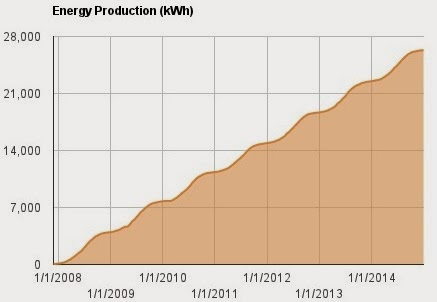
Our little 4kW solar system generated 3,800 kWh in 2014. Here is a chart of the production since we installed our panels:
Seven years of energy solar energy production
2014's production was enough to drive my electric car about 11,000 miles. During the year, I only drove about 7,400 miles.

2014 Solar Powered EV Driving
This left us with about 1,700 kWh of energy that were not used by our EV driving. This reduced our home energy bill. This is especially helpful in the summer when the home AC is on.

Our home is in rainy Oregon, our PV system is a small (4kW) system, and it is facing-west (rather than the more optimal south). If solar powered driving can work here, it can work in a lot of places on the globe.

Oregon Sunshine (Eriophyllum lanatum) flower by Arboreal Boids