 |
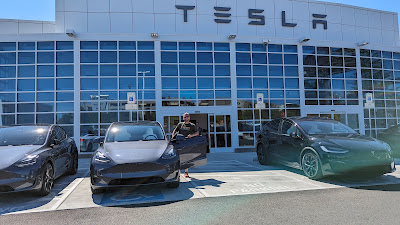
| Delivery Day at the Tesla Service Center |
We just purchased a Tesla Model Y. After we've had some time with it, I'll post my thoughts on the vehicle and ownership experience; but for this post, I have two questions related to the battery: One, How big is the battery pack? Two, How far can I drive? Plus a little fun.
How Big Is The Battery Pack?
I wanted to know "How big is the battery pack in a 2023 Tesla Model Y Long Range AWD?"
Seems like a straight forward question, but getting the answer was much more difficult than I thought.
Without dragging this out, here's the answer I landed on:
The battery pack capacity in a 2023 Tesla Model Y LR AWD is 84.6 kWh.
If you want to know how I got to that answer, read on.
Since the Model 3 was launched, Tesla no longer badges their vehicles with the battery capacity, so it's not just written on the back of the car.
As one does, first I googled for the answer and I found results all over the place. The only problem is none of them agreed and they seemed more like guesses than authoritative answers.
- InsideEVs said it is "around 81 kWh."
- The Car Guide online said it's 75 kWh.
- EV Database says it's 78.1 kWh. (very specific, but no source info)
Okay, the web does not know or, at least, does not agree, so let's go to the Monroney sticker. This label doesn't list the battery capacity, but it does say the efficiency is 28 kWh per 100 miles and the range is 330 miles. So with just a little math, that's: (28kWh * 330 miles)/100 miles = 92.4kWh. This is significantly more than the numbers above, so I was skeptical and wanted to double check it.
The Monroney sticker also says Model Y has an efficiency of 122 MPGe. The math was a little more complicated and resulted in a ~91 kWh capacity size. That's 5 estimates, and none of them agree and the variance is pretty large. But the Monroney sticker is from the EPA; it must be more reliable than some google search. Right? Right?
I found out that the range and the efficiency are calculated with different tests. So you cannot use those two in the same calculation. That means that my two 90-some kWh calculations are invalid.
Strike one, the web. Strike two, Monroney. Time for a third (better?) source.
To certify a vehicle for sale in the US, the manufacturer has to submit the EPA test results along with information about the vehicle. These documents are public records, so I looked at the Model Y docs.
Here are the relevant bits from the document:
 |
| From 2023 Tesla Model Y AWD EPA Test results |
First, I find it funny that EV information is lumped under the "Hybrid" category. I also want to point out that this test was done in September of 2022. The cover page says it's for the 2023 model year vehicle, while the comment in the snippet above says "2022 MY" Model Y. Tesla does not really use model years, so take this as you'd like.
The Tesla submitted EPA document says the battery pack voltage is 360V and that the Energy Capacity is 235. Capacity of 235, but 235 what? There are no units listed. A little digging and I found that this is Amp-hours. Given these to values and we can finally derive the size (360V * 235 Ah = 84.6 kWh). This certainly seems like a better answer than any of the previous. If you know of a better source for pack size info, please let me know in the comments.
You can see the complete document
here. Looking at it in more detail, it has several recharge sessions listed where more than 91kWh are used during charging. That does not mean that the battery capacity is that big, there are always some loses during charging for things like heat, thermal management, power electronics, controls...
One important note, assuming the 84.6 kWh is the right size, that does not mean that all of the battery capacity is available to the driver. Automakers often hold back a portion of the battery to improve longevity.
Special thanks to domenick on TeslaMotorsClub for helping me find these resources.
Model Y AWD LR Range
My next question: What is the range of a 2023 Tesla Model Y Long Range AWD?
The Monroney sticker says 330 miles, but there's a reason that we have the expression Your Mileage May Vary. I found a hypermiler who goes by the name madmanquadsix that was able to drive 356 miles on a single charge. I'm no hypermiler, EVs are sporty cars and driving 5 or 10 MPH under the speed limit (as hypermilers often do) is no fun (and can even be dangerous). So I have no expectation of meeting madman's results.
As we saw in the capacity calculations above, the Monroney sticker led us to the incorrect conclusion that the vehicle had a battery pack of over 90kWh. So, let's assume it's wrong about the real-world range too. Using the pack size that we've determined (84.6kWh) and the 28 kWh per 100 miles yields a range of 302 miles. This seems a little more realistic and frankly is the range that should be posted on the Monroney label, IMHO. And note, if you were to drive that entire 100% to 0% drive, the car would be alerting and speed limiting during the final part of the drive, so that makes the usable portion more like 275 miles, unless you enjoy stress.
Even though I think the EPA stated range is too rosy (for all cars), it is still far better than the WLTP (Worldwide Harmonized Light Vehicle Test Procedure), and the NEDC (New European Driving Cycle). These two tests both have longer range estimates for the Model Y. The WLTP estimate is 350 miles and the NEDC range estimate is a whopping 398 miles; nearly, 400 miles! That is even more than the madman hypermiler was able to achieve. Having an estimated range that far off, one that is nearly impossible to achieve is just setting people up for disappointment and failure.
Range (regardless of fuel source) can be significantly impacted by elevation changes, wind, weather, road conditions, climate control use, speed, driving style, tire pressure, tread, and wear, towing, roof attachments... Given all of this, I wouldn't just assume you can jump in and drive 300 miles before charging up. A little planning helps and Tesla makes that easy.
 |
| Tesla In-vehicle Energy Graph |
It's not about general range, it's about "Can I get to where I need to go?"
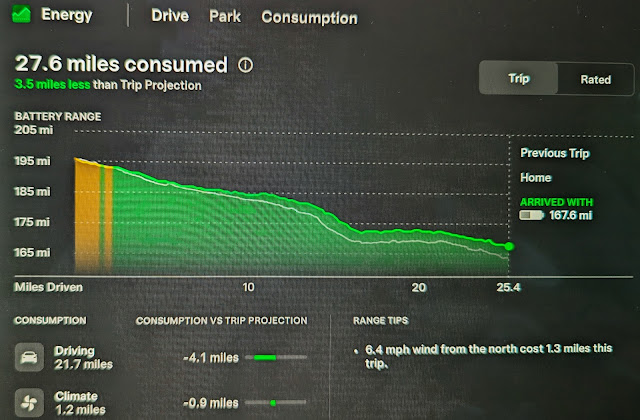
The route planner in Tesla vehicles is awesome. Pop-in a destination and it takes many factors into consideration, plans a route with charging stops (if needed), and shows you the expected battery pack discharge profile, consuming more energy as you ascend a hill and regenerating energy as you coast down the other side. It even shows you the round trip results, so you know at a glance if you can make it home without a charge stop.
I use the route planner and energy graph on most drives. I like to watch the accuracy of the prediction and I like to see if I can do just a little bit better than that. As Tesla often does, they have iterated this feature, considering more factors and looking at historical data... all resulting in better estimates.
The image above is a great example. This was a ~25 mile drive, with freeway speeds and 1,118 ft of elevation gain. It was a hot day in August; the AC was on. The route planner expected to use ~31 miles worth of range. The drive was completed using only ~27 miles of worth of range.
Using the in-vehicle (and soon in-app) trip planner allows you to have the confidence to know you'll make it there with charge to spare.
That answers my two questions:
- Q: How big is the battery pack in a 2023 Tesla Model Y LR AWD
- Q: What is the range of a 2023 Tesla Model Y Long Range AWD?
- A1: EPA Range is 330 miles
- A2: real-world range is 275 miles* YMMV
Model Y Accessories
This car was our new fun toy and we had to buy a few things to personalize it a little.
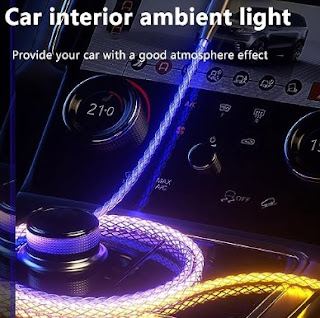
The USB ports in the Model Y (in all Teslas today) are USB-C. The majority of my cables are USB-A (at least on one end), so it was time to upgrade. There are two USB ports in the center console, so an illuminated USB cable is an easy and affordable way to have some cool ambient light and makes it easier to find stuff in the cubby.
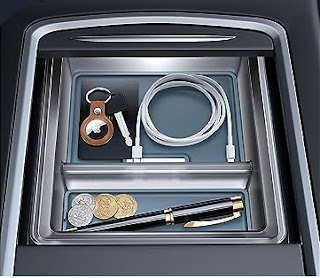
Next on the list was a center console organizer. There are two reasons I liked this one better than the others. One, it slides forward to give you easy access to the lower level. Two, is it transparent, so the ambient light that's plugged in below glows through.
Next on the list, driving glasses holder. I like to keep shades in the car in a place where they won't get scratched or dirty. The easy-close strong magnet on this one closes with a satisfying snap. I picked the carbon fiber finish. There are many colors available (you do you).
No one likes trash on the floor of their new car. So where to put it? A bag, that's not a clean look either. The solution is a cyber-can. It fits in a cup holder. I put it in the kicker panel so the center cup holders are available for caffeination.
This is one of my favorite upgrades: Puddle lights. I was intimidated the first time I swapped these in, but it was easier than I thought it would be. It's a nice touch that people see when getting in or out.
This one is a nice subtle little touch that people are not likely to notice but it improves the experience. And they are super easy to install. You can get them with or without the Tesla logo. I think these go especially good with the midnight silver metallic paint.
The final Model Y accessory that we've purchased so far is a car smart dog leash. This one is cool because it has a seatbelt clip. This makes it easy to keep your furry friend in the second row. You can even use it with the second row seats folded down. The seat belt clips are right under the 60/40 split. It has a short bungee section to take the jolt out when they tug, a clip for poop bags, and it's reflective at night. The perfect lead for our needs.
There you have our list of Tesla Model Y accessories. I hope find something that brings you a little joy.
Disclosures:
This article contains affiliate links