Thursday, December 31, 2015

10,000 CHAdeMO, 1 Million EVs, & 1 Billion Tesla Miles - The Big EV Stories of 2015


2015 was a big year for electric vehicles. Here is my list of the things that mattered most for plug-in transportation in 2015. If you think I left something off the list, please let me know.

In no particular order:
  • More than 100,000 plug-in car were sold in the US in 2015. With the cheap price* of gas, that's impressive. This put nearly 400,000 plug-in cars on US roadways.
  • September '15 saw the One Million EVs Sold Worldwide milestone crossed  
  • COP 21 put CO2 top of the world's mind. Many CO2 reduction plans came out of Paris and many of these include increasing the number of EVs on the world's roads. 
  • Dieselgate, the VW scandal,  made people realize that diesel is a fossil fuel, not a green alternative.
  • Tesla, LG, & BYD all break ground on battery gigafactories. 
  • Grid storage battery applications were announced. This helps in multiple ways: it advances battery tech, increases the volume (lowering prices), and increases the amount of renewable energy that can be used on the grid.
  • Now that some plug-ins have been out for 5 years, a real used market has emerged and there are some great deals. This will open the market to more people and to people that would only consider them as a second car. As we know, many of them will fall in love with that smooth ride.
  • With CAFE increases, the gasoline tax is dying. Several states are rolling out alternatives; however, it's not clear if these are simple funding replacements, or punishments to EVs and fuel efficient car drivers. 
  • Nissan offered a Leaf with a larger battery pack. This is the first step toward the promise of affordable 200+ mile EVs coming soon (Bolt, Model 3). 
  • Tesla auto-pilot: an innovation breakthrough that is a big step to autonomous vehicles.
  • Tesla was not bought out by Apple, Google, or anyone else. These stories were annoyingly hyped in 2015. 
  • In December Nissan sold their 200,000 Leaf in worldwide sales
  • The Case for a Carbon Tax: The state of Oregon specifically made progress toward establishing a carbon tax. This would do much to reduce gasoline use while simultaneously increasing the amount of renewable energy on the grid (which powers EVs and everything else that plugs in).   
  • In June '15 Nissan/Renault crossed the 250,000 electric cars sold milestone.
  • Tesla drivers passed 1 billion electric miles mark in December.
  • Toyota launched their fuel cell car, the Mirai. This is the next step in the fight between electricity and fuel cells to be Fuel 2.0
  • Electric cars dominated the Pikes Peak International Hill Climb, placing first and second. The elevation gain of more than 4,000 feet makes it hard for the gas cars to calibrate for the O2 intake change. EVs will soon dominate in other races (like the TT) and leave their gas-power brethren in the dust.
  • According to energy.gov there are 29,627 charging outlets at 11,667 locations in the US. EV infrastructure continued to grow in 2015.
  • In December of 2015, the number of CHAdeMO stations crossed the 10,000 mark for worldwide deployment.  
  • CCS fast chargers finally began their proliferation in the US. They are still far behind CHAdeMO & Tesla.
  • China has struggled to get EVs to sell. In 2015 they finally found the right incentives and infrastructure deployment to start ramping EV sales. BYD outsold all other manufacturers.
  • Plug-in car plans were on display at the 2015 Detroit auto show. Porsche, Volvo, Audi, Ford, VW, Jaguar and others all announced big plans in 2015 for future EV growth.  
The future is going to be electric! Happy New Year.
* Cheap at the pump does not mean cheap cost when all the externalities are considered. 

Friday, December 11, 2015

Nissan Leaf Turns 5 - Incremental Improvements Add Up

The first Nissan Leaf was sold on December 11, 2010. The 2016 model year vehicles are currently available, making this the  sixth model year. Let's look at how the Leaf has evolved.

Looking back before we look forward

Chevy S10 Electric Vehicle
My first electric vehicle (EV) driving experience was in 2007. Lucky for me, there were still a few EVs around from the late 1990s. Thanks to Don't Crush (now Plug In America), not every EV from the turn of the millennium era suffered the same fate as the GM EV1. I found a Chevy S10 Electric pick-up. It was great. It had more than enough range for my commute, it went 70 MPH, and having a truck was pretty handy.

One day a couple other S10 EV drivers and I got together to swap stories. When we met, of course we started checking out each other's trucks. The other two were the 1997 models, while mine was the 1998. The differences were subtle, but very noticeable to an owner. The '98 added a rubber seal between the cab and the bed and there was a valance on the bumper. These were minor changes, but they looked like small efforts to improve the vehicle's aerodynamics.

Looking at even these minor improvements, we wondered what a 2007 electric Chevy truck would look like. Unfortunately, there was no 2007 model (or even a 1999 model year) since GM stopped making these trucks after these first two model years. That question has stuck with me. How would EVs improve year over year with continued iterations and technological advancements?

2011 launched a new generation of plug-in vehicles

With the reintroduction of EVs in 2011, we finally have a several model years of some plug-in cars to compare. Both the Chevy Volt and the Nissan Leaf came out in December of 2010 and the specs for the 2016 vehicles are available. This gives us of 5 years of cars and we can see how they have evolved from the 2011 model year to the 2016 vehicles.

EVolution of the Nissan Leaf

As we look at each year, I'll be focusing primarily on the range, drivetrain, and battery tech. New paint colors or backup cameras are nice, but not important in this context. The 1st year Nissan Leaf was EPA rated at 73 miles of range and it had an efficiency rating of 99 MPGe or (my preferred format) 2.94 miles per kWh.

The 2012 Leaf had the same EPA range and efficiency. This model year also added heated seats and a heated steering wheel. This allows the occupants to be warmed directly, rather than heating all the air in the car first. The high-voltage battery pack has more insulation and a warming system for extremely cold environments.

Nissan integrated electric powertrain
2013 brought the first redesign of the Leaf. Nissan integrated the motor, inverter, DC reducer, and power delivery module (PDM) into a smaller and lighter package. This reduced the volume of these components by 30% and their weight by 176 pounds. This increased the luggage space by more than 10%, improved the regenerative brake system, and reduced the amount of a rare earth element by 40%.

Nissan continued to improve the heating system by exchanging the immersion heater for a heat pump. The heating system has turned out to be very important in an EV. When a vehicle has the energy equivalent of less than one gallon of gas, it is important that anything that consumes this energy is highly efficient (just ask Mark Watney).

All of these changes resulted in a notable improvement in the driving efficiency. The EPA rating jumped from the 99 MPGe of the 2011/12 to 115 MPGe (3.45 miles/kWh). The EPA range, however, was only 75 miles. The reason the EPA rated range didn't increase a corresponding percentage is complicated. With a full charge, the 2013 Leaf earned an 84 mile EPA range. However, in 2013 the EPA changed the test. A new rule stated that if the vehicle offered an 80% charge (which the Leaf did to extend the battery life), then this would be tested too. With an 80% charge the Leaf only scored a 67 mile range. The final 75 mile range was the average of the 100% range and the 80% range (84 and 67).

In 2014, there were only minor physical changes. One notable software change was that the 80% charge option was removed. This meant that the EPA would now rate the Leaf's range only on its 100% charge. With this software change the Leaf scored a 84 mile range. Minor changes to the EPA test reduced the efficiency rating to 114 MPGe or 3.33 miles/kWh.

The 2015 model was again a small change. The range and efficiency remained the same as the 2014 vehicle at 84 miles and 3.33 miles/kWh. There was, however, one important battery improvement that does not show up in the EPA tests. The 2015 introduced the much anticipated “lizard” battery. This was an improvement to the Leaf's battery chemistry to make it more tolerant to extreme heat. Owners in places like Phoenix were experiencing advanced battery degradation due to heat. This was bad PR for Nissan and the new batteries were an important part of repairing the relationship with these early adopters that took a chance on the technology.

The 2016 Leaf was a big change from the 2015. This is the first year that Nissan offered two different battery size options. The 24 kWh battery is the same as the 2015 with an EPA-rated range of 84 miles. The new 30 kWh battery pack, provides an EPA rated range of 107 miles.

Here is a snippet from Nissan press release:
The new 30 kWh battery design adds capacity without increasing battery package size by improving the cell structure of the laminated lithium-ion battery cells. Improved electrode material with revised chemistry results in higher power density and enhanced battery durability upon charge and discharge.
It is also worth noting that the base price for the 24kWh Leaf dropped to $21,510. This is significantly cheaper than the $29,010 base price of the 2015 Leaf.
Correction, the base model MSRP was not reduced in 2016. Fueleconomy.gov has an incorrect price listed. Thanks to reader "aarond12" for the correction on the MyNissanLeaf forum.

Here's a table of the Leaf model years to-date:

Year Range (miles) Efficiency
(miles/kWh)
Notes
2011 73 2.94 1st Year
2012 73 2.94 Added heated seats &
steering wheel
2013 75/84 3.45 Integrated elec. powertrain
2014 84 3.33 80% charge opt removed
2015 84 3.33 Heat tolerant "lizard"
battery
2016
(24kWh)
84 3.33 New lower MSRP
2016
(30kWh)
107 3.33 1st battery capacity
increase for the Leaf

So, Nissan addressed cold weather areas by adding a better heating system that use less energy and they addressed hot weather regions by improving the battery chemistry. They also increased the battery capacity in 2016. Nissan will undoubtedly increase the range again when competitors such as the Chevy Bolt and the Tesla Model 3 come to market.

Nissan Leaf ratings from fueleconomy.gov

Sunday, November 29, 2015

How Driverless Cars Change Will Our World

1930s Elevator Operator
When you hop on an elevator are worried that there is no elevator operator there to close the doors and guide the elevator to the floor that you want? Unless you just popped out of a time machine from 1930, you probably don't think twice about getting into an elevator and pressing a button and letting the elevator automatically take you there.

Today, many people are concerned that driverless cars will not be as good or as safe a driver as a person. We think things like: Well, maybe it will be better than most drivers but certainly, it won't be better than me because I am a far better driver than most people on the roads. The illusory superiority (from which we all suffer) tells us that we're better than average, when in fact most of us fall within two standard deviations of average.

According to the Portland Herald Press "About 33,000 people die each year in auto accidents. In 80% of cases the cause is alcohol, speeding, or a distracted driver." If you have been driving for any significant amount of time, I'm sure you can think of a time that you were tired or distracted and should not have been driving. Autonomous vehicles won't have any of these distractions. Given time, autonomous vehicles will be better than nearly every human driver on the road. You can argue how long it will take for the technology, regulations, and laws to advance, but for the sake of this article, let's assume that it's now 2040 and driverless cars are commonplace and people are just as comfortable with them as we are with elevators today. In this imagined future, if you want to see a manually operated car, you would have to go to vintage tracks or a car museum, where children will point at steering wheels and ask "What's that?".

Vintage Car
Assuming a future where vehicles are fully autonomous and fully trusted, how would our world change? How would it impact employment, traffic, car ownership, parking lots, suburbs, inner-cities, roadways, vehicles, vehicle ownership, home locations... Let's speculate.

Generation-next will be as comfortable in autonomous cars
as we are in elevators.


Today, most cars are parked 22+ hours per day. Once you have an autonomous vehicle, why not put it to work when you aren't using it. It could operate in Uber or Lyft networks. It could run many of your daily errands, pick-up groceries, dry cleaning, etc. It could be common to list the license plate number of your car on pick-up orders and have the business load items into the trunk. Of course, the trunk will have connected streaming video cameras to make sure they don't take anything out that they shouldn't. Your car could even drive itself in for its maintenance appointments.

Many people have said that once we have autonomous vehicles, that there won't be any traffic congestion. This is not a certainty. If it is cheap and easy to send a vehicle out, they could end up driving many more miles. Another congestion-alleviating item that is often attributed to autonomous vehicles is that they will be able to travel significantly faster than human-piloted vehicles. Again, this is debatable. Even with radar vision and nanosecond reaction time, the stopping distance depends on the vehicle weight, tires, and road conditions. Unless there is a radical vehicle redesign, these factors will not change significantly. This should limit any speed increase.

Speaking is a radical redesign, vehicle trains are an item that could reduce future congestion. Next Design has an idea to create interlocking pods that allow vehicles to couple to vehicle trains on the fly. This could double the capacity of our roadways.

Swarming modular self-driving vehicle concept design by Next

As vehicles change from machines that we operate to traveling domiciles, the interior space will change to meet our new needs. The first-class seating area on a transcontinental flight might be a better model for future car interiors than the vehicles we drive today. Once we are no longer driving, travel time will be an opportunity to work, play, watch movies or TV, or to sleep and rest. There will be places to plug in our mobile devices, cameras for video chats, and windows that can be tinted when you want to sleep or to have privacy.

Intercontinental first-class seating is a better model for future autonomous
vehicle interiors than the cars we drive today.

Lie-flat first-class intercontinental seating 
City center property is expensive. Today, out of necessity much of this high-value land is dedicated to parking. Once you have autonomous vehicles, they won't need to park near your work. Large parking areas, 5 or 10 miles from the city center, could ring the city. Parking would be significantly cheaper or free there. That is, assuming your car parks at all. Rather than parking, your car might spend its day available for hire and running errands as discussed above.

Rather than competing with public transportation, autonomous cars could be the first/last mile solution that makes public transportation accessible to many more people.

Rather than competing with public transportation, autonomous
cars could be the first/last mile solution that makes public
transportation accessible to many more people.


Assuming you have a job that requires you to be in the office occasionally, if you have a fully connected mobile office in your car, it might give telecommuting a new definition. Today, commute time is a drain on your time. If instead, commute time were productive, it could become a standard part of your workday. This might even mean that you could take a job that is farther from your home. Imagine projecting a telepresence (Skype/Facetime) into your office space that your coworkers could walk up to and chat with you as your ETA is displayed as you are being shuttled to work.

What about people that drive for a living? I started this article discussing elevator operators. The people that once had this job found other ways to make a living. Today, in the U.S. more than 2.5 million people have driving jobs (1.7 million truck drivers, 650,000 bus drivers and 230,000 taxi drivers). This is about 2 percent of the U.S. workforce. The change will not happen overnight, so there won't be 2.5 million people put into unemployment all at the same time. However, disruption is coming, so I would not encourage anyone to start a career as a driver today.

This is, of course, just speculation. It will be interesting to see what happens as the technology rolls out. Autonomous vehicles are coming, the question is how will we adapt to them.

Monday, November 16, 2015

Model 3 Will Be The Cornerstone of Tesla's Uber Fighter

First there was Tesla Motors, the electric car company. Then, in 2015, Tesla Energy was introduced. What's next for Tesla? Based on comments in the recent earnings call, we may be seeing Tesla Transportation, the autonomous taxi service.


During Tesla's Q3'15 earnings call Adam Jonas from Morgan Stanley asked Elon Musk “If Uber wants to buy 50 thousand autonomous cars, why not cut out the middle man and deploy your Tesla autonomous mobility service?”

Elon laughed and refused to comment. Jonas persisted, asking if that was a dumb question and asking why Elon was laughing. Elon replied “It's quite a smart question actually.” Jonas continued to press and Elon said that “Our strategy is not fully baked. We'd prefer to announce something when we think we've got the full story understood.”

This certainly implies that Tesla is considering something in this space. What other things has Tesla done that might indicate their plans?

Tesla has previously released a video of the "charging snake" that can automatically plug in a car for recharging. Plugging in is not that hard for a person to do. It is not a significant problem that would warrant the engineering effort needed to make a Doc Ock arm.  


If, however, these self-driving cars need to charge up, they would not have a driver to plug them in. So, perhaps the charging snake was part 1 of the autonomous fleet plan.

What will Tesla's plan look like when it is "fully baked"? Will it be a car sharing service or an on-demand taxi? Will be be pay-per-ride or a membership?

The affordable mass market Tesla Model 3 will undoubtedly play a large roll in whatever Tesla has planned in the mobility on-demand space. If they want to put vehicles in major markets around the world, that would be expensive to do with $100k vehicles.

So someday soon (2020?) you may be able to summon an autonomous Tesla to chauffeur you around.

Saturday, October 31, 2015

Your Car Will Drift To Save Your Life

Autonomous drive systems are under development from Mercedes-Benz, Nissan, Tesla, Google, Apple, and others. Today, these systems are nascent but the pace of innovation in this area has never been greater.

Even in this early form, you can find examples of automatic braking systems preventing accidents. Tesla's autopilot has only been out a few weeks, it is beta and still has bugs, but it has avoided accidents that the drivers didn't even see coming. As this technology improves, the cars will gain more abilities.

Here is one example of how things will improve. Today, most cars have antilock brakes. In most situations, antilock brakes are the right way to conduct an emergency stop. However, there are cases when a side skid would stop shorter. However, today's systems value control and maintaining the vehicle in its lane over absolute stopping distance.

Professional Driver Drifting Around A Corner
Today's simple antilock brake systems have no idea why you are hitting the brakes. They operate the same if you brake because the car in front of you stopped or if a kid runs in front of your car. An autonomous driving system, on the other hand, will have far more information.

Soon autonomous driving will arrive at the place where chess is today. Computers may not be better than the best humans in the world, but they're better than 99.9% of the population. And you don't need a supercomputer to run them; even the chess apps you can run on your smartphone are really good. In a simplified view, autonomous driving is just chess plus physics and computers are really good at both of these.

Autonomous driving is just chess plus physics and computers are really good at both of these.


Professional drivers will take the cars on tracks and preform J-turns, bootleg turns, handbrake turns, drifting, and other get-away stunt driver moves. The telemetry of all of these will be recorded and analyzed. It's unlikely that you'll ever need Dukes of Hazzard or Mach 5 moves to avoid an accident, but it won't be long until autonomous drive systems have complex evasive maneuvers in their bag of tricks.

It won't be long until autonomous drive systems will be able to perform J-turns or drifting maneuvers. In very rare cases, these maneuvers could be employed to avoid accidents.

For example, let's say you are in a future fully autonomous drive vehicle. You are coming up to an intersection and your light is green, so your car enters the intersection. Then suddenly you see to your left, headed directly at you, is a driver coming very fast that is running the red light. Because of a building on the corner, you (and the autonomous drive system) could not see this driver coming. A car is now headed directly at you at a high rate of speed. There is a car in front of you that limits your egress. The autonomous drive system accelerates and then turns hard towards the car. What? Towards the car; is it crazy? This maneuver skids the back end away from the oncoming car. Your car then skids to a stop, sideways in the (unoccupied) crosswalk. Collisions were avoided with both the red light running vehicle and the vehicle in front of you.

If you were in a driving simulator and could try this scenario over and over, you may eventually come to use this same move, but in a real-life situation, it is unlikely that your spur of the moment decisions would be the one that turns toward an oncoming car. Most people would either rear-end the car in front of them or slam on the brakes and prepare for impact.

Kobayashi Maru no win situations are another intriguing aspect of autonomous drive systems, but that will have to wait for another day.

Thursday, October 29, 2015

Traveling the OReGO Trail - Dead Battery & Phantom Trips (Pt2)

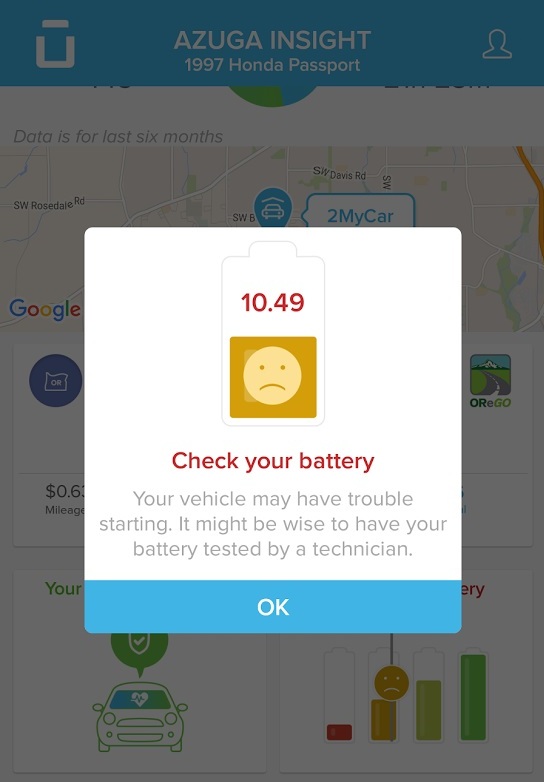
As reported earlier, the OReGO program is reporting that my battery Voltage is low. It was low, but I installed a new battery (and terminal connectors) and topped the Voltage off with a smart charger. Despite this, it still reports as low on the OReGO dashboard.

You can see in the two images below, that the Voltage is normal.

Battery Voltage Level w/ vehicle off
Battery Voltage Level w/ vehicle running
So above, you can see that the Voltage is normal. Here is what OReGO shows:

OReGO Dashboard Reports
The Battery Voltage As 10.49V
Today, the Azuga program manager for OReGO called me and explained that they found the bug that is causing this problem. In short, the bug is that the device sends a message when the Voltage is back above 10.5V. If the vehicle is garaged or in an area with poor cellular reception, this message could be lost. If this message is lost, then the Voltage level is not sampled again.

They have two fixes for this. First, the short term fix (coming soon). It will work this way: Every time the vehicle is started, any low Voltage state flags will be cleared and the system will return to normal Voltage reporting. Second, the long term fix (requires more code changes) works this way: battery Voltage levels will be reported along with other telemetry data. These messages require acknowledgement from the receiver or else they are retransmitted (like TCP traffic on the Internet).

So there you have it, the mystery of the low battery Voltage is solved (and will soon be fixed).

Now all that is left to figure out is the cause of the phantom trips. The Azuga program manager also mentioned that another vehicle in the program was experiencing this issue too. Ironically, the other vehicle is a Nissan LEAF (my daily driver).

Tuesday, October 27, 2015

Toyota's Future Transportation Vision

Toyota recently released a report of their vision of the future. They predict that plain old internal combustion cars will be a thing of the past by 2050. You can see in the chart below the mix of vehicle types that they are projecting.

In 2050, Toyota predicts the mix of new cars will be approximately one-third hybrid, one-third plug-in hybrid, and the final third is split between EVs and Fuel Cell Vehicles  (FCV). It's interesting that Toyota would lump EV and FCV into the same category when they have made such a big deal of saying that EVs are not future for primary personal transportation. They have said that EVs will be a niche product for urban travel only and that FCVs will be the vehicle of choice for most drivers. Are they hedging their bet? More on that later.

Another thing I find interesting about the above graph is that hybrids have been on the market for 15 years are are still only have a 3% market share. Yet, they predict that over the next 35 years this market share will grow to 33%. I understand why Toyota might want this to be the case. The hybrid market is dominated by the Prius. If the hybrid market were to grow 10 X, Prius sales see tremendous growth.

Toyota would love to see the hybrid vehicle market grow significantly. However, given the small market share after 15 years, tremendous growth is unlikely.


I see two things wrong with the assumption that the hybrid market will grow significantly. First, plug-in vehicle sales are growing faster than hybrid sales ever did. Plug-in vehicles are coming out from every major vehicle manufacturer; whereas, outside of the Prius, hybrids models have been meager. Second, once you have a hybrid vehicle with batteries and a drive system that can combine an electric motor and a gas engine, it doesn't take much more engineering to make a plug-in hybrid (add more battery capacity and a charger). As battery energy density increases and prices drop, it will become a small upgrade to go from a 50MPG hybrid to a 100MPGe plug-in hybrid. If you care about fuel economy, fewer trips to the gas station, or just not paying as much to get around, the extra cost of a PHEV over an HEV will be worth it. PHEVs will eclipse HEVs and limit HEVs market growth.

As battery technology advances, plug-in vehicle sales will cannibalize the hybrid market and limit its growth.
Let's get back the fuel cell vs battery electric vehicle discussion. Later in the report Toyota has a breakdown of which market segment they think each vehicle type will sell into. Here is the graph:


Toyota seems to think that EVs will dominate the market in golf carts, weird leaning vehicles, and micro cars. I guess they have not heard about Tesla or the list of "Tesla fighters" in the luxury EV market. These vehicles are long range BEVs and they don't appear on Toyota's vision of the world in 2050.

Apparently, Toyota has never heard of Tesla and doesn't think batteries will improve by 2050.
Looking at the right side of the graph, they have heavy vehicles dominated by fuel cell drive systems. Here is something that we agree on. As I have previously stated, long range heavy vehicles or fixed route vehicles (such as dock vehicles, buses, garbage trucks, or mail trucks) are excellent opportunities for FCVs. Passenger cars, on the other hand, are not viable until an extensive hydrogen refueling infrastructure is in place. Battery electric vehicles do not suffer from this limitation since any electrical outlet can be used to refuel them.

So the outlier in the FCV bubble is the passenger vehicle shown as a Toyota Mirai. I guess, in Toyota's 2050 vision, there is an extensive H2 refueling infrastructure. I'd like to see their deployment plan. H2 will have to compete with electricity. Electricity is cheap and convenient, so it will be hard to make a profitable business plan around H2 refilling.

Electricity is cheap and convenient. It will be hard make a profitable H2 refilling business plan that can compete with electricity.
This concludes my critique of Toyota's 2050 vision. The future will be interesting.


Tuesday, October 20, 2015

Traveling the OReGO Trail - Dead Battery & Phantom Trips

This is another entry in my journey with the Oregon vehicle mileage program called OReGO.

As I reported here, I have been having battery issues since signing up for OReGO. I have also been seeing phantom trips show up in the driving log. I joked that that after your battery dies, your car can become haunted.

Well, while not a haunting, it turns out that the phantom trips may actually be related to the battery issues. The OReGO website has a new feature that reports your vehicle's Voltage level. Here is what they show for mine currently:
Battery Voltage Reported on OReGO Website

Just before this feature went online, OReGO support called me and said that my battery Voltage was low and that might be the cause of my phantom trips. They recommended that I drive or idle the vehicle more often to keep the battery charged. Ironic that they would include idling the vehicle as a suggestion since you lose points in their gamification scoring system when you idle.

While, I agree that driving the vehicle more would keep the battery charged, I don't want to drive my gas hog vehicle any more than I need to and I am certainly not going to idle. That is just wasteful. So I did two things, I put a new battery in and put it on a genius battery trickle charger until it was full.

New battery on a charger

However, even after the battery was full, the phantom trips continued to occur. The OReGO site also continues to show that the battery Voltage level is low, even when the charger showed it as full and in the dash Voltage gauge shows ~13V.

So the saga of the dead battery and the midnight phantom on the Oregon trail will continue.


Traveling the OReGO Trail:
July 19, 2015 - Signing Up - Why?
July 23, 2015 - Saddle Up
July 27, 2015 - First Trip
July 29, 2015 - Jumpy GPS
July 31, 2015 - Jumpy GPS Response
August 20, 2015 - The Big Trip (well not that big)
September 25, 2015 - Dead Battery
October 6, 2015 - Dead Battery Response
October 15, 2015 - Phantom Midnight Driver

Saturday, October 17, 2015

Stephen Colbert "I woke up yesterday and my Tesla could drive itself" (video)


I recently wrote about how my car is taking phantom trip and driving itself around in the middle of the night. Well now there actually is a car that can drive itself. Tesla has released their Autopilot software update.

The feature has been covered by the press ad nauseum, you can find videos of journalists and owners letting go of the wheel and freaking out and gushing about the car. And rightfully so, this is a threshold moment in history. Here is how it was covered on Stephen Colbert's Late Nite television show.


The clip highlights how Tesla is not an ordinary car company, they treat the car like a modern connected smart device and deliver over-the-air updates.

Thursday, October 15, 2015

Traveling the OReGO Trail - Phantom Midnight Driver


Just in time for Halloween, my car has apparently become haunted. I guess that can happen after your battery dies, LOL. So why do I say that my car is haunted? As you know, I have a state issued tracking devices in my vehicle. This means that all the trips my car makes are tracked and there are some trips in that log that I did not take.

Here is a recent log entry from October 1st:

As you can see, just after midnight, the vehicle started to move. Only, I wasn't driving it. <scary> These short phantom trips continued until 4PM the next day. On other days these phantom trips have happened at 3 to 4 AM.

Adding up all these up, it would be $0.27 in charges. However, with the fuel tax rebate that is part of the program, these will not amount to much. But what if I were a fleet manager? I'd wonder why people were taking my vehicles up and down the street in the middle of the night and I had to pay fees for it.

I wonder if this is just another case of jumpy GPS or maybe I have something like a loose battery terminal cable and it is related to the dead battery issue that I had.

On the plus side, this did earn me a badge for driving more than 7 hours in a day #gamification


Traveling the OReGO Trail:
July 19, 2015 - Signing Up - Why?
July 23, 2015 - Saddle Up
July 27, 2015 - First Trip
July 29, 2015 - Jumpy GPS
July 31, 2015 - Jumpy GPS Response
August 20, 2015 - The Big Trip (well not that big)
September 25, 2015 - Dead Battery
October 6, 2015 - Dead Battery Response