We installed solar panels in 2007 and we added more panels in 2011. Now, all these years later, it's time to replace our roof and we want to keep our solar panels. Where to start?
I had a lot of questions:
- How does that work?
- How much does it cost?
- Are the footings for the solar racks removed too?
- How are the roof penetrations sealed until the new roof is installed?
I'll tell you all the answers I found to these questions. You'll see the contractors we used and how our experience went. I hope you find it helpful.
Eventually, all roofs need work, so if you have solar panels or you're thinking about solar panels, this could be helpful information.
Don't Bury the Lede
I usually like to tell the story of our experience and how that led to the conclusions. In this case, I'll reverse that. Here's what I learned. If the conclusions make sense to you, then you can stop reading. If you disagree or don't understand, read on to see how we came to these conclusions (then you can disagree while being well-informed).
So let's just answer each of the above questions:
This process is called a "Removal and Reinstallation" or R&R. Here are the steps:
1) The solar panels are removed and stored on-site.
2) The mounting system rails are removed and hauled off.
3) The feet of the mounting system are left on the roof (to be removed along with the old roof). This is so roof penetrations are not exposed and cause leaks. Depending on the footing materials, they can be removed for recycling on roof removal day.
4) The old roof is removed.
5) The new roof is installed.
6) The next step is "Wait." This is a step I didn't expect. I learned that the new solar panels are not installed immediately after the new roof is installed. Instead, after the new roof is installed you have to wait for a "curing time*". This can be 14 to 30 days.
7) Finally, the solar panels are reinstalled (along with new footings and a new racking system*). Then the panels are reconnected to the inverter.
* more on these questions below
- Q: How much does it cost?
If your original installation contract included an R&R clause, you'll want to exercise that option because it can save you money. We had two PV systems on our roof. One had this clause and all 36 panels were removed and reinstalled for just $500. The other, our smaller PV system, on the other hand, had no such clause and we received quotes anywhere from $200 to $300 per panel. With the "per panel" portion of those quotes, the costs add up quickly. We had 20 panels in the smaller system, so using the cheapest bid, it was $4000; on top of the roof expense. So, in total (not counting the roof), our R&R was $4500. This is just to get the solar panels that we already have on our roof removed and then put back. Since they were doing all this work, I considered upgrading but decided to just keep the panels that we have.
- Q: Are the footings for the solar racks removed too?
Here's another thing that I didn't know. Completely new rack mounting systems are installed as part of the R&R process. Both of our installers did this. There are a couple of reasons: first, rack systems are not that expensive compared to the panels and inverter; second, rack systems have improved significantly over the last decade. Newer systems are quicker to install and less likely to cause roof leaks (I like that).
- Q: How are the roof penetrations sealed until the new roof is installed?
The rack footings are left on the roof so leak holes are not exposed while waiting for the roof removal crew. These are removed with the old roof. One of our PV systems had aluminum footings. We recycled those.
Our Story
We first had solar panels installed in 2007 by a local installer called Mr. Sun Solar and then we had a second system installed in 2011 by SolarCity. Sixteen and twelve years later respectively in the summer of 2023, our roof was old and needed to be replaced.
3 Contractors?
We have two solar PV systems on the roof. The roof under them was pretty bad and many of the plywood sheets needed to be replaced. This meant the entire solar system, mounting rails and all, needed to come off. The three contractors were the roofer (Geek Roofing - they don't deal with solar panels), Tesla (they won't touch the non-Tesla system), and Sun Path (for the Mr. Sun Solar system).
1: Tesla
Our contract with SolarCity/Tesla includes an R&R clause that says they will remove and reinstall the system one time, for the small fee of just $500. They would not touch our other, non-Tesla panels 😞 so we had to find a second solar contractor for that work.
2: Sun Path
The other, older, PV system was installed by Mr. Sun Solar. They are no longer in business, so we had to find someone else to remove and replace these panels. It took a lot of phone calls and emails. We were told over and over by various solar contractors that they would not touch a system they hadn't installed. After calling about 20 solar companies, we finally found 3 companies that would do it. The bids ranged from $200 per panel to $300 per panel. There are 20 panels in this system. That means the cost ranged from $4000 to $6000 to remove and reinstall the system. I understand that it is a lot of work and they need to be paid for it, but in the end, we just have the same PV system that we started with. Compared to the $500 for the Tesla system, $4000+ is hard to swallow. After confirming the contractor license and checking BBB for complaints (and finding no complaints), we selected the cheapest bid, Sun Path Services. I was really happy with their work (more on this later).
3 Geek Roofing
Oh yeah, the point of all of this was to get a new roof. We contacted several roofers and received 4 bids. We were hoping to find a roofer that could also handle the non-Tesla R&R, but had no luck there. Some made referrals, but none would do it themselves or subcontract it.
After looking at all the quotes, unlike the solar remove/reinstall, we didn't select the cheapest bid this time. Roofing materials have improved greatly since our original roof was installed in the mid-1990s. We selected Geek Roofing because they impressed us with their presentation, attention to detail, and advanced materials. The contract included gable vents, a new skylight, and more.
Timeline Scheduling
We wanted to have the panels off the roof for as short a time as possible. With three contractors to coordinate, this was not easy; here's how it went.
May 26th - Tesla Solar Removal
7AM: The doorbell chimes! They are here to start the removal of the SolarCity Tesla panels. It's a team, 5 members strong. I snap a couple of before pictures of the roof/panels. They put an empty pallet on the patio and leaned ladders against the house as if storming a castle. Up the ladders they go; our guard dog barks, and Here Comes The Rooster rings out from their boombox as they work; a little revenge on my neighbors for all those early morning leaf blowers and pressure washers😆 An hour or so in, a battery from a portable tool, tumbles off the roof and hits the deck with a loud 'thump'; startling, but no damage to anything or anyone below.
9:30AM: Just two and a half hours later, the panels are stacked up on the patio. The crew is packing up and I snap a couple of after photos. They left several meters of wiring conduit on the roof. I pointed that out and said, "This is still on the roof and needs to be removed so the new roof can be installed there." The Tesla rep assured me that it is no problem for the roofers to slide under those. They also left the mounting pucks/feet on the roof. They said they're left on so they don't expose roof penetrations and cause leaks. They can be removed and disposed of with the old roof. They hop in their truck and van and they are off to another job. It was impressive how fast they were. Cost: $150
 |
| Old roof with solar panels removed |
 |
| Tesla Solar Panels Stacked Up |
10:30AM: I sent photos of the conduit to our roofer and asked if this was going to be a problem. I was ready to call Tesla and tell them to come back and finish the job. I didn't want to have our roofing crew show up and then not be able to get started because there was still solar wiring on the roof. To my surprise the roofer said it was 'no problem'; they could work around it.
June 5th - Mr. Sun / SunPath Removal
1PM: The dog barks and I look out the window to see a truck pulling up. It was Chet from SunPath. He was here right on time to remove the Mr. Sun Solar panels from our roof. Unlike the crew from Tesla, this was a one-man effort. Chet removed the panels and rails and carefully leaned the panels against the fence (these are 16-year-old panels after all). Cost: $1300
June 9th - Roofing Supplies Arrive
7:30AM - Doorbell chimes, I was still in bed asleep. Throw on some clothes and open the door. The shingles and other roof supplies were here. This job is scheduled to start in 2 or 3 days and they didn't tell us to expect a delivery before then. I move the car out of the driveway and a giant crane truck moves in. It hoists pallets of roofing materials off the truck and up onto the roof. This seems like a much smarter way to do it than carrying them up a ladder by hand. 20 minutes of pounding supports into place and craning it all up there and they were gone. Some materials were left in the driveway. We moved these to the side of the house so we could go in and out of our garage.
 |
| New Shingles Arrived |
June 12th - Roof Removal Day
A big deuce-and-a-half style truck backed into our driveway at 7:45AM. Tarps went down and ladders went up. The hammering and sawing went on throughout the day as materials rained down and fell in (or at least near) the bed of the truck.
 |
| Old Roof Removal |
June 13th - Roof Install Day
The new roof is going on. Our old roof didn't have air intakes on the roof or an apex vent; the new one will. The new air intakes are generally installed 3 feet from the gutter; however, this area will be covered by our solar panels. So the roofing team decided to install the air intake a little lower on the roof so air flow is less likely to be impeded by the panels.
 |
| New Roof Being Installed |
June 14th - Final Roof Day
For the final day, we have a half crew. They were installing the new skylight and cleaning up.
June 15th - Pressure Washing and Haul Away (guess yesterday wasn't the final day)
They ran the nail magnet around the house one more time. Final walk-through. There were a few minor things that were found in our review with them: The flue was supposed to be repainted, the pressure washing job was not complete, and one of the roof anchors was missing.
June 16th - Pressure Washing Round 2 - Fix the things from the final walk-through
They fixed all the issues from the walk-through and our new roof was looking good.
 |
New Roof Complete
(now it's time to get the panels back up there) |
Tip: Magnet Sweep It For Yourself
A tip I received from a friend was to run a magnet over my lawn before mowing and over the driveway before driving over it. I assured him that they had a big rolling magnet and they ran it over the area twice, so that was unnecessary. He insisted, dug out a magnet wand that he had, handed it to me, and said that he'd buy me a beer if I didn't find a bunch of stuff they missed. With nothing to lose, I couldn't say 'no' to that deal.
Well, he was right and I didn't get that free beer, but I did avoid a punctured tire and having my lawn mower blade launch a nail at the speed of sound into who-knows-what. Here are the things I found:
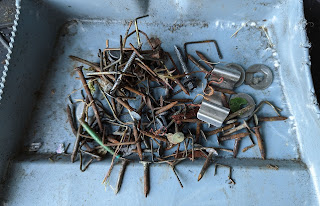 |
| Found After Roof Work |
I cannot tell you that all of this is from this job. Some of them are pretty rusted and may have been there for a while, but now they are collected. I also cannot promise to buy you a beer if you don't find anything after your roof work, but I do highly recommend that you use a
magnetic pickup tool after any roof work.
Scheduling the Solar Reinstalls
Now that the roof was complete, I wanted to get both PV systems back to production as quickly as possible; some sunny days were coming.
I text SunPath first. They quickly got back to me and said they could be there on July 5th. That was easy.
Tesla, on the other hand, was not so simple. Our Tesla energy rep was not returning my emails or calls. I tried to schedule the reinstallation via the app, but we already had an open "Remove and Reinstall," case (and had someone assigned to it) so I didn't want to open another one that was just a reinstall. Eventually, with nowhere left to turn, I called the customer support line, went through the long phone tree, waited out the hold time (thank you for the 'hold for me' feature on my phone), and finally, I talked to someone. They updated our case, flagged it for scheduling, and said that I would be able to schedule the reinstall date in the app in 3 to 5 days.
"Cure Time"
Both SunPath and Tesla require a waiting period after the roof is complete before they will reinstall the solar panels. SunPath required 2 weeks and Tesla required 30 days. I guess this is to make sure there are no problems with the roof before they go up and there.
Reinstall - SunPath
July 5th SunPath Reinstall Day
The SunPath crew of three people arrived at 8AM. They laid out all the panels in the grass and cleaned them. The panels were really dirty and desperately needed to be cleaned. The new panels were completely installed and ready to power on before 2PM.
Power-on unfortunately was not smooth. The old SMA SunnyBoy inverter didn't want to start up. They spent a couple hours on the phone with SMA support before they found the magic settings that would allow the old girl to get going again. Cost: $2700
Reinstall - Tesla Solar
August 11th Tesla Solar Reinstallation Day
The Tesla crew arrived just before 8AM. All the panels were installed and wired up before 11AM. But there were two problems. One, the panels were really dirty. They have sitting on a pallet under a tree for 6 weeks. You can see how dirty they were in this photo:
 |
| Dirty Solar Panels |
I asked them to clean the panels. They said, "No problem," and hosed the panels off. They cleaned up easily.
The second problem was a grounding wire. It's not easy to see, but if you look left of the house, you can see the wire hanging down in this photo:
 |
| Dangling Ground Wire |
It looks like they forgot about it. I asked them to reconnect this. Seems like it might be important. They said they'd take care of it. Great, I went back in the house. I came back out about a half hour later and they were gone. Okay, they could have knocked and said they were done.
I did a walk-through to see how it all looked. I could see things running at the inverter. I could see the solar production in the app. They didn't leave any gear. So far, so good.
Then I got around to the corner of the house with the grounding wire. It was gone. Rather than reconnecting it to the solar panels, they just removed it. When they reinstalled the panels, they didn't put them back exactly where they were the first time. They shifted them about a meter away from this ground wire. Rather than extending the wire, they just *removed* the ground wire completely. If you know anything about electricity, then you know ground connections are an important safety concern.
I immediately messaged them. I didn't know if it was safe to leave the system operating without this wire connected. I received a reply that simply said that "the grounding wire was not needed" with no additional information.
I was not happy with this terse response. I asked for more information. I explained that before the removal, there was a connected ground wire, so part of reinstallation must include reconnecting this ground wire and that I was not sure that it was safe to keep the system operating without this connected. Again the only response I received was "This wire is not required." Ugh. I insisted that they install the grounding wire. They refused.
This was a removal and reinstallation. No changes to the system were part of the deal. I was not a happy customer.
Are you can see, things were not going well with Tesla. They were failing at communications. I expressed a safety concern and received a condescending "don't worry about it" response. Cost: $350.
SunPath to the Rescue
I remembered the SunPath folks telling me they have done several Tesla R&R jobs. Maybe they know more about the ground wire. So I emailed Chet at SunPath and asked him about it. If it was needed, I was ready to pay him to do what Tesla had refused to do.
The answer I received from Chet was comprehensive and explained (in detail) that the Oregon electrical code was updated a few years ago and that auxiliary ground wires like this one were no longer required by code. Aux ground wires are no longer part of new solar installations and it is not required for safety. I wish Tesla would have given me this information (at least the second or third time I asked). Cost $0 - priceless peace of mind.
 |
| Final Reinstallation |
Now that it was all done, Geek Roofing wanted to double-check things and make sure the solar installers had not messed up their roof. They came out in a car, with no ladders. I was wondering how they were going to check the work without getting up on the roof. The answer was a drone. The little thing buzzed up there and landed on the roof near the panels. The camera was low enough that there was a clear view of the roof under the solar panels. The drone hopped from spot to spot as they checked various spots and connections. They gave it a thumbs up and hit the road. I received a copy of the video later that day.
Lessons Learned
- If you are installing a PV system, make sure your contract has an R&R clause in it. This saved us $3500 for the system that had it ($500 compared to $4000). Roof damage and aging can happen and this clause will save you some money at a time that you're already spending for a high-dollar item in a new roof.
- Pick a larger solar company. There's no guarantee that they will still be in business 10+ years later, but the odds are a little better and things happen and you may need some service.
- Sweep for nails, clips, staples, etc. even after they have.
- If you want prompt attentive service, pick a local installer. (I know this is at odds with lesson #2)
- Your costs associated with solar R&R work might be eligible for tax incentives.
Check For Incentives
If you're considering solar, it's worth looking into the incentives that are out there. In the US, there's a 30% federal incentive. In Oregon, there's a $0.20 per Watt incentive. If you're in the Energy Trust region, there's an additional $400 incentive. If you qualify, these can add up.
Referrals
If you're within 50 miles of SunPath's office in Beaverton, Oregon; I recommend getting a quote from them for your solar project. Also (after you have the quote) if you tell them you were referred by Patrick from CarsWithCords.net, you'll get $500 off and I'll receive a referral bonus.
If you're considering Tesla for your solar project, you can use my referral code (
https://ts.la/patrick7819) for $500 off and I'll receive referral points for Tesla merch.
Ω


.png)
.png)


.png)


