Sunday, April 9, 2023
I Like Big Batteries - Battery Prices Will Drop (3/3)
Sunday, March 19, 2023
I Like Big Batteries - We Demand Supply
The Supply Crunch
EV popularity is increasing. EV sales from 2012 to 2021 are up 13 fold and the upward trend seems unstoppable. Well, almost unstoppable; there may be one thing that could slow this trend: battery cell availability.
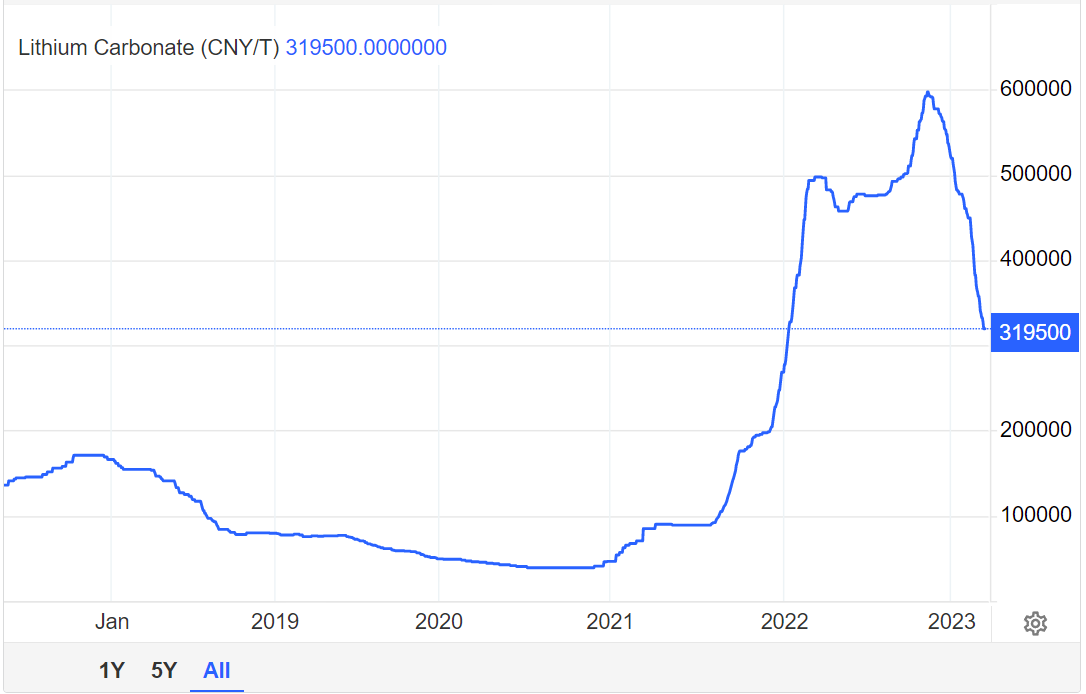
Battery materials (such as Nickel, Lithium, and Cobalt) costs have skyrocketed over the last two years. Prices are being driven by high global demand and a tight supply of refined materials. Lithium carbonate prices per tonne were up 88% year-to-date in October of 2022.
As you can see in the two graphs below, in 2022, Nickel hit a 10-year high and Lithium hit an all-time high.
![]() |
| Nickel price history via tradingeconomics.com |
![]() |
| Lithium Carbonate price history via tradingeconomics.com |
More Mining, Refining, and Recycling
Obviously, these higher material costs are not going to help make EVs or energy storage more affordable, but there is a plus to the higher prices. Inflated prices mean it's more profitable to mine and refine these materials. This will bring in more investment and more of the needed materials.Once these materials are mined and in batteries, they will be available for this generation of battery tech and the next and the next, ad infinitum. These materials are not consumed like fossil fuels. They are not emitted from a tailpipe or smokestack into the atmosphere. The Nickle that is put into batteries today, will be recycled and put into new, better batteries in the next decade.
The increased cost of raw materials also makes it more profitable to recycle batteries. More on recycling later, back to mining and refining.
![]() |
| Caterpillar's First Battery Electric Large Mining Truck |
Mining Is Getting Greener
Most EV makers have goals to have zero emissions manufacturing. This starts with mining. More mining equipment is becoming electrified. In some cases, the very materials they are mining are the same ones used in the batteries powering the mining equipment.
![]() |
| Normet SmartDrive battery electric mining vehicle |
Demand for EV battery raw materials such as graphite, Lithium, Cobalt, and Nickel is currently outpacing supply. According to Benchmark analysts, unless 384 new mines are up and running in the next ten years, the EV transition will be slowed as carmakers struggle to source battery materials. They estimate that 74 Lithium mines, 62 Cobalt mines, 72 Nickel mines, and more than 100 graphite mines and production plants are needed.
For comparison, there are currently about 3,760 active coal mines. So, assuming the above estimates are correct, EV batteries will need about one-tenth the number of mines that are currently active, just for coal.
Battery Recycling
The good part about these battery materials mines is that they are not consumed after they enter the battery lifecycle stream. The materials can be recycled and placed in new batteries after they degrade beyond usefulness. It can become a closed loop. So unlike coal mines, these materials will reach a state where nearly all of the needed materials can come from recycling streams; rather than a never satiated gaping maw.
The recycled material streams will be of higher purity since the recycled materials have effectively been refined multiple times and this will result in better batteries. Additionally, recycled materials will be less subject to supply chain disruption and more affordable than newly mined materials. The recycling plants will be near where the batteries are produced, rather than wherever the random vein of various materials happens to lace the Earth.
"Ephemeralization" - computers from the 1960s used to take up an entire room, now the smartphone in your pocket has far more computing power. This same march of progress is happening for batteries, albeit at a slower pace. Battery energy density is increasing by about 5% each year.
This wraps up part 2. Part 3 (prices will drop) is coming soon.
Sunday, March 12, 2023
I Like Big Batteries - Why
Today, we use batteries in everything from our electronics (phones, watches, tablets, earbuds), to power tools, toothbrushes, and electric cars. Battery tech is more important to our daily life than it's ever been. And now that the tech is maturing, it is being bundled together into bigger batteries than ever before for new purposes.
We'll look at how batteries, specifically big batteries, are being used and (more importantly) how this is laying the foundation for the "Electrify Everything" future.
Why Big Batteries...
Battery-based energy storage is vital to our renewable energy future from moving people and goods to smoothing out the intermittent nature of renewable energy. For transportation, to replace all the towing, hauling, and road trips that internal combustion vehicles are used for today, we're going to need EVs with big batteries. For renewable energy to power the lights, air conditioners, and heat pumps in a major city, we're going to need big storage batteries.
Grid Stabilization & Renewable Energy Storage
![]() |
| Power inverters outside the battery building at Moss Landing Energy Storage Facility in Moss Landing, California. Credit: David Paul Morris/Bloomberg via Getty Images |
Industrial Energy Storage
Home Energy Storage
Big Batteries Can Move People and Goods
Personal Transportation
Electric Semi-Trucks
On-highway and medium-duty trucks from Freightliner are shipping now. These freight trucks currently have 150kWh to 300kWh of battery capacity depending on the intended use. These are not small batteries.Tesla's all-electric class 8 commercial semi-truck completed its first 500-mile trip with a full load in November of 2022. The first customer deliveries started in December of the same year. Musk has said that Tesla aims to produce 50,000 semi-trucks in 2024. As I write this, the full specs have not yet been released. However, the pack is estimated to be more than 900kWh. We'll be seeing megawatt-hour packs soon.
Thursday, March 2, 2023
Tesla Master Plan 3 is About Moving to Earth 2.0
![]() |
| Earth 2.0 by Dall-e2 |
- A sustainably powered world can be a world of abundance
- Electricity gets more done with less
- Battery energy storage enables a renewable energy economy
One, A World of Energy Abundance
Two, Meet All Your Energy Needs More Efficiently
Three, Big Batteries
Four: No Miracles Required
Sunday, February 19, 2023
The Idling Rich - Carbon & Money
Who will suffer the worst impacts of climate change? The poor.
Who has the resources to do something to resolve climate change? Certainly, we can all do our part and we can all vote for reasonable climate policy... But the answer for the purposes of this blog post is: The rich.
The rich are the ones that could afford to build zero-emission apartment buildings, fund eco-friendly start-ups, buy zero-emission fleet vehicles, and so much more.
The ‘1%’ are the main drivers of climate change, but it hits the poor the hardest: Oxfam report
How do we get people in the second group to care about what happens to people in the first group?
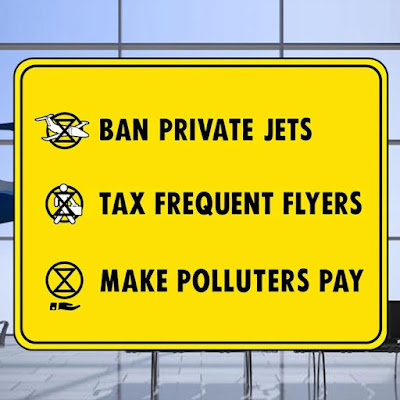
The jet-setters are flying around for important red carpet events, all-the-while burning jet fuel. The ironic part is that some of them are flying to events where they will be talking about how important it is that we take action regarding climate change. Is that irony or hypocrisy (maybe both)?
There's no question that with more income, quality of life improves (up to a point). Along with this improved quality of life, generally comes an increase in emission output. So, we have to have a system that allows for an improved quality of life, without increasing emissions.
We cannot depend on everyone having personal solar panels and their own new EV. Sure these should be encouraged, but we also need a grid that is renewably powered and zero-emissions public transportation.
Fossil fuels are only viewed as cheap because the true price includes an environmental debt. One that is not paid at the pump. The externalities for emissions need to be included in that fossil fuel price. This levels the playing field for renewables.
Sunday, January 29, 2023
EVs for Everyone, Better Batteries :: F, GM, TSLA :: Revisited
Guess when this was written:
“Now there's a growing demand for electric car batteries. With GM, Nissan, Ford, and Tesla ramping EV production, battery usage in electric cars could begin to drive a meaningful segment of the battery market. As a result, a number of improved battery designs are being developed in laboratories, involving silicon, graphene, and a zinc-air composition to name a few.”The above is not an exact quote, there are a few tweaks (removing vehicle introductions) so the answer was not too obvious. Drumroll please... This was written on April 12, 2013.
Why does this matter? The goal is EVs for everyone, whether it's personal vehicles, public transportation, or rideshare; with all of this powered by renewable electricity. However, there are a couple obstacles.
Why Are EVs Expensive? Batteries!
Battery Prices are Dropping
Boom and Bust
![]() |
| Via @skorusARK |
Better Living Through (Battery) Chemistry
Paying The Iron Price
Closing the Loop
Tuesday, January 10, 2023
2023 Tesla's Two Million Vehicle Year!

Last year, we wondered if Tesla would be able to produce 2 million vehicles in 2022. Our determination and that it wouldn't happen in 2022. Tesla's final production number for 2022 was 1.369 million.
Tesla's Guidance 2.05 M
Exponential Growth 2.18 M
Linear Growth 1.86 M
Other Factors
Wrapping Up
Sunday, January 8, 2023
Energy Portfolio - Solar, Wind, & Batteries
“Don't put all your eggs in one basket.”
That ol' phrase is good advice for many things in life. One example is investing. A mutual fund is a basket of different stocks. This is safer than owning just an individual stock. To be even safer, you could hold a combination of stock mutual funds, bonds, and cash. If stocks are down, maybe bonds are up. If both are down, well at least you still have the cash. But this is not a financial blog and that's not financial advice, so let's move on to our usual topics EVs and Energy.
This same diversity of assets lesson is now being applied to renewable energy.
Oregon Public Broadcasting (OPB) reported that Portland General Electric, the largest utility in Oregon, is building a large-scale wind, solar, and battery facility.
OPB says, “Nestled in the hills of Morrow County, hundreds of solar panels and wind turbines are generating a product that will soon be in high demand around the state — clean electric energy.”
This is the diversified energy portfolio: solar, wind, & batteries.
Wind: Morrow County, Oregon is near one of the best windsurfing regions on the continent in the Columbia River Gorge.
Sun: Morrow County is also in the sunny eastern part of Oregon (really, it's not all rainy there).
Batteries: The 30 MW/120 MWh of batteries here will absorb the surplus energy when the sun and/or wind are making more than the grid needs. And it will fill in the gaps when the wind dies down or clouds pass over.
The goal is to have this site supply renewable energy 24 / 7 / 365.
With renewable energy, just as with investing, if reliability is your goal, diversity is a good thing. This is an energy portfolio of solar, wind, and batteries. Continuing the investing analogy, you can think of the solar panels as stocks, they are great when the sun is shining. The wind turbines are like bonds, they're not as sexy, but they are less volatile and often perform when stocks/solar don't. And finally, we have batteries, they are like cash-on-hand, you know exactly how much you have and you can save it or spend it as needed at your discretion.
Ok, enough for the finance talk. Solar, wind, and batteries complement each other well. The solar panels will generate energy during the day and (of course) nothing at night. This generally scales well with increased daytime energy use. Solar also scales seasonally with more generation in the summer when the air conditioners are humming. Solar production is significantly diminished in the winter up here north of the 45th parallel; however, this is when the winds tend to really blow. And finally, you have batteries to fill in the gaps and absorb the excess.
A surprisingly small amount of energy storage (batteries) will make a big impact on the grid; this will be a game-changer for renewables on Oregon's grid. Batteries are what changes renewables from a volatile source that spikes the grid with power one moment, then little to none the next moment, to something that the grid can use to add stability. Batteries are instantly dispatchable. I call this digital energy.
Managing batteries is a new challenge for electric utilities. There are lessons yet to be learned. Such as where's the best place to physically locate the batteries? Is it at the generation location (as in this facility) or should the batteries be closer to the consumption location? Or some combination?
Oregon's last coal plant closed in October 2020. This new installation is about 30 miles from the shuttered coal plant. My favorite part of this story is that the transmission lines that once carried the dirty energy from the coal plant will now transmit renewable power from this renewable energy farm.
Right now, we have the technologies that are needed to move to a future free from fossil fuels. We don't have to wait for fusion or some other big breakthrough. Let's put the resources that we have, here and now, to work. Most deployments are held back by a lack of political willpower, not a missing technology.
Here in Oregon, we have the political will, and our major electric utilities are required to move to emission-free generation. The Clean Energy Targets bill (HB 2021) requires utilities to reduce emissions as follows:
- 80% below baseline emissions levels by 2030
- 90% below baseline emissions levels by 2035
- 100% below baseline emissions levels by 2040
#ElectrifyEverything
#100PercentRenewable
#FutureFreeFromFossilFuels
#KeepItInTheGround
Thursday, December 29, 2022
Oregon Joins West Coast Gas Car Ban
The Oregon Environmental Quality Commission voted to approve the Advanced Clean Cars II Rule at a special meeting December 19th. The rule is based on vehicle emissions standards initiated by California.
How Big Of A Car Market Is This?
California is the top region for automotive sales in the US. As of 2021, car sales in California was $137 billion and accounts for ~12% of US car sales. Add Oregon's $13B and Washington's $21B and that brings you to $172B market or 15% market share. This is obviously far too big of a market for automakers to just walk away. They will need a robust EV line-up.What About The Other CARB States?
Massachusetts and New York have also adopted similar rules. These five states together account for almost a quarter of the U.S. population. This is adding more fuel to the fire to stop burning fossil fuels (pardon the anachronism).Tuesday, December 27, 2022
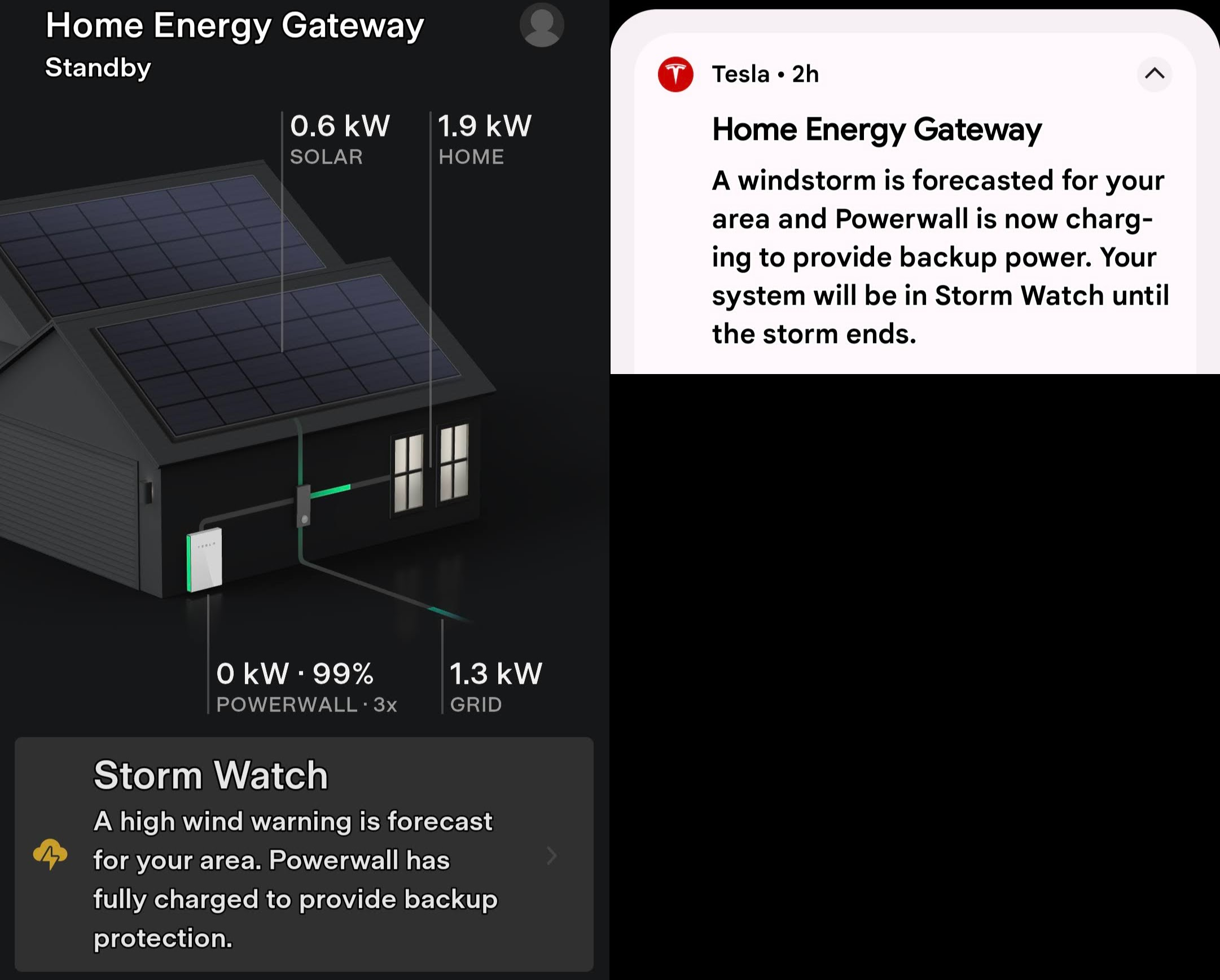
Powerwalls and Power Outages
Look at the map above. This is the region where I live. More than 55 thousand people here are currently without power right now. We had an Arctic blast blow through with snow and ice last week and this week there's a wind storm taking out branches and trees. To pile on to all of that, there's domestic terrorist movement that somehow thinks that attacking electrical substations will manifest their extremist political agenda.
Tesla Powerwalls don't have a "grid under attack" setting (yet).
There's no good time to lose power, but during a winter storm is the worst. Without power, you cannot run your furnace to stay warm. This is true even if you have a gas furnace because power is needed to run the fans and control systems. If you opt to evacuate to stay with friends or family or to check into a hotel, the road conditions can make travel difficult. These storms and outages can be deadly.